
When Does Car Insurance Go Down?


Key Takeaways
blueCheck icon

Car insurance rates drop most at ages 18 and 21. Young men see bigger decreases than women because they start with higher rates.

blueCheck icon

Violations stay on your record for three to five years, depending on how serious they are and your state's rules. DUIs take five to seven years to clear completely.

blueCheck icon

Getting married usually cuts car insurance rates by 15%. Married drivers file fewer claims than single drivers.

blueCheck icon

Improving your credit score can lower premiums by 20 to 30% in most states. It's one of the biggest ways to reduce your rates.

blueCheck icon

Life changes can drop your rates right away. Examples include removing a teen driver from your policy, moving somewhere safer or finishing a defensive driving course.

At What Age Does Car Insurance Go Down?

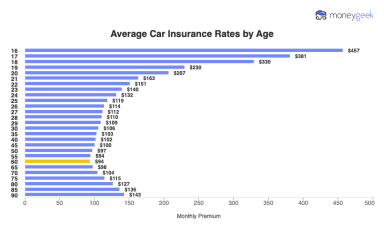
Car insurance rates generally fall as drivers gain experience and show safer driving behavior. For most people, premiums drop steadily between ages 16 and 24, with the largest decreases tied to a few key age milestones insurers use to reassess risk.

Rates tend to stabilize after the mid-20s. At that point, age matters less than your driving record, claims history, and coverage choices.

Age Range
Rate Change
What Triggers the Decrease

16–18

12–15% annually

Gaining initial driving experience

18

First major milestone

Insurers recognize improved experience for 18-year-old drivers

21

Major rate decrease

21-year-old drivers exit highest-risk category

25

Final major age-based reduction

25-year-old drivers reach statistical maturity

25–30

2–3% annually

Continued experience improvement

How Much Does Car Insurance Go Down by Age and Gender

Insurance rates don’t decline the same way for everyone. While both male and female drivers see lower premiums with age, the pace and starting point differ, especially during the teenage years.

The table below shows how average annual costs change by age and gender, highlighting how the gap narrows as drivers gain experience.

16$7,550$7,699$149
17$5,906$6,018$112
18$5,050$5,144$94
19$3,623$3,674$51
20$3,239$3,284$45
21$2,533$2,567$34
22$2,315$2,345$30
23$2,126$2,152$26
24$2,002$2,026$24
25$1,752$1,775$23

Key Gender Gap Statistics

At age 16, females pay $149 more annually than males. This female premium gap narrows to $23 by age 25. The gap narrows as drivers gain experience. By age 30, the rates become nearly identical between genders.

Male drivers see insurance rate decreases at ages 18, 21, and 25 (the same milestones as female drivers). Men see larger dollar decreases because they start with higher premiums.

locationPin icon
STATE-SPECIFIC VARIATIONS

California, Hawaii, Massachusetts, Michigan, North Carolina and Pennsylvania prohibit gender-based pricing. In these states, male and female drivers pay identical rates at all ages. If you see gender-based rate differences in these states, contact your insurer immediately, as this violates state law.

Some states prohibit gender-based pricing. Consult your state's insurance regulations for specific requirements.

How Violations Affect Your Car Insurance Rates?

Violations don’t affect car insurance rates indefinitely, even though the increase can be steep at first. On average, traffic violations raise premiums by 53%, but insurers apply these surcharges for a defined period. Understanding how high-risk drivers are classified makes those timelines easier to predict.

Violation Type
Rate Increase
Record Retention

Speeding (6–10 mph over)

22%

3 years

Speeding (11–20 mph over)

28%

3–5 years

Reckless Driving

73%

5 years

DUI/DWI

93%

5-7 years

Hit and Run

95%

7–10 years

Violation timelines vary significantly by state and may change based on local regulations. Contact your state's Department of Motor Vehicles or insurance commissioner for current requirements in your area.

vs icon
WHEN TO SHOP AFTER A VIOLATION

Once a violation clears your record, consider shopping for a new rate. Most insurers won't lower your premium at renewal without prompting. Comparing quotes at that point is the fastest way to capture the savings.

State-by-State Violation Timeline Variations

Violation recovery timelines vary by state. Progressive reports that speeding tickets may drop off your driving record within three to five years, depending on how long your state keeps violations on its records.

    california icon
    California

    Most violations stay on record for three years, but serious violations like DUI remain for 10 years. California drivers should understand these state-specific timelines.

    texas icon
    Texas

    Moving violations typically remain for three years, with DWI convictions staying for 15 years. Texas drivers face some of the longest DWI penalties in the country.

    florida icon
    Florida

    Most violations stay for three to five years, but DUI convictions remain for 75 years.

    newYork icon
    New York

    Moving violations stay for four years, serious violations for 10 years.

driverLicense icon
MULTI-STATE LICENSING COMPACT

Most states participate in the Driver's License Compact (a system where states share violation information across state lines). Getting a ticket in another state will typically affect your home state's record and insurance rates. Only Massachusetts, Michigan, Tennessee and Georgia don't participate in full information sharing.

Ways to Lower Your Car Insurance Rates

Beyond age and violation recovery, several life events trigger immediate premium decreases. Understanding these factors helps you plan for rate reductions.

    coupleS icon
    Marriage Impact on Insurance Rates

    Married drivers pay an average of $194 less per year than single drivers. This reduction occurs because married drivers file fewer claims and are viewed as more stable.

    Here's what marriage can do for your rates:

    • Average rate decrease: 15% for married vs. single drivers
    • Multi-car discount potential: Up to 25% when combining policies
    • Bundle discount opportunity: Additional 5% to 15% when adding homeowners insurance
    • Rate increase risk: If the spouse has a poor driving record, rates increase instead
    teen icon
    Teen Driver Removal

    Removing a teen driver from your policy results in immediate and substantial savings. Based on our rate analysis, families typically save $1,500 to $2,500 annually when a teen leaves for college or gets their own policy.

    Teen drivers must meet state-specific licensing requirements and may be subject to additional restrictions, including supervised driving hours, passenger limitations and nighttime driving restrictions that vary by state. Consult your state's DMV for complete legal requirements before making coverage decisions.

    goodCredit icon
    Credit Score Improvements

    Americans with poor credit scores pay much more for car insurance than those with excellent credit. Improving your credit score can trigger 20 to 30% rate reductions in most states.

    California, Hawaii, Massachusetts and Michigan prohibit using credit scores for insurance pricing. If you live in these states, focus on other ways to reduce rates, like improving your driving record or increasing your deductible.

    locationPin icon
    Moving to a Safer Area

    Your ZIP code impacts your rates. Moving from an urban area with high theft and accident rates to a rural or suburban location can reduce premiums by 10 to 40%. Insurance companies reassess your risk profile based on your new address.

    carVsCar icon
    Driving Experience vs. Age

    Two 26-year-olds with different experience levels see different rates. A driver who just got their license pays more than someone who's been driving for 10 years. Insurance companies prioritize actual driving experience over chronological age.

    If you got your license later in life, expect to pay rates closer to those of a young driver until you build two to three years of clean driving history, at which point most insurers reassess your risk tier at renewal.

    badCredit icon
    Credit History Impact

    In most states, your credit score affects your insurance rates more than you might expect. Drivers with excellent credit (750+) pay 20 to 30% less than those with poor credit (below 600). Improving your credit score can trigger immediate rate reductions at your next renewal.

    car2 icon
    Vehicle Type and Safety Features

    Your car's safety rating, theft rate, and repair costs influence your premiums. Switching to a vehicle with better safety ratings or lower theft rates can reduce your rates by 10 to 25%. Anti-theft devices and safety features like automatic emergency braking can qualify for additional discounts.

    carInsurance icon
    Coverage Changes and Deductible Adjustments

    Increasing your deductible from $500 to $1,000 reduces your premium by 15 to 20%. However, ensure you can afford the higher out-of-pocket cost if you need to file a claim. Consider dropping comprehensive and collision coverage entirely for older vehicles worth less than $4,000.

coins icon
LEARN MORE ABOUT SAVING ON CAR INSURANCE

Although car insurance rates are higher when you're younger, there are practical ways to lower them. These five tips are the most common approaches, but you can get more information from our article on reducing car insurance costs.

Compare Cheap Car Insurance Quotes

Many factors besides age contribute to the cost of car insurance. Because providers consider so many variables, compare rates from multiple carriers. Our calculator below can help you get started.

Company-Specific Rate Reduction Policies

Insurance companies handle rate reductions and violation forgiveness differently. Knowing these differences helps you pick the right insurer for your needs.

Company
Accident Forgiveness
Violation Forgiveness
Teen Driver Programs
Credit Score Impact

GEICO

Available after 5 years

Limited

Good Student Discount

High

State Farm

Available with good record

Limited

Steer Clear Program

Medium

Progressive

Available for purchase

Limited

Snapshot Program

High

Allstate

Available with Platinum status

Limited

Drivewise Program

Medium

USAA

Available to members

Limited

SafePilot Program

Low

Insurer policies on accident forgiveness, violation forgiveness, teen programs, and credit weighting vary by state and change periodically. Verify current program availability and eligibility directly with each insurer before choosing a policy.

How to Choose the Right Insurer for Your Needs:

  • Young drivers: Check out insurers with solid programs for teens, such as State Farm or GEICO.
  • Drivers with violations: Companies like Allstate offer accident forgiveness programs that can help keep your rates manageable.
  • Credit-conscious drivers: USAA and some local insurers tend to put less weight on credit when setting rates.
  • Safe drivers: Progressive and Allstate have usage-based programs that reward careful driving.

When Does Auto Insurance Go Down: Bottom Line

Car insurance rates drop at predictable points, most often as you gain experience, age out of higher-risk groups, or move past violations. The biggest decreases usually happen around ages 18 and 21, and after tickets or accidents fall off your record.

Savings don’t happen automatically. Comparing quotes regularly, keeping a clean record and asking about discounts make the biggest difference. Serious violations like DUI take longer to recover from, but rates do improve over time with safe driving.

When Do Car Insurance Rates Drop: FAQ

We answer common questions about when and why car insurance costs go down.

When does car insurance go down after marriage?

How long do violations affect car insurance rates?

Does insurance go down every six months?

What happens when I remove a teen driver from my policy?

How does moving affect my car insurance rates?

When should I file a claim vs. pay out of pocket?

How often should I shop for car insurance rates?

What happens if I miss car insurance payments?

Average Car Insurance Cost by Age: Our Review Methodology

We designed our research to track how rates actually change across age groups, so you can plan your insurance budget and know what to expect. 

Sample covers national trends. Your actual rates may vary based on your state's rules, local ZIP code, and insurer availability in your area.

We analyzed real rate data to show you when car insurance costs drop and by how much. Our analysis comes from state insurance departments and Quadrant Information Services, covering 22,848 quotes from six providers across 100 ZIP codes. This gives us the breadth to show national trends while capturing regional differences that affect your actual costs.

Auto Insurance Rates by Age: Related Articles

About Mark Fitzpatrick


Mark Fitzpatrick headshot

Mark Fitzpatrick, a Licensed Property and Casualty (P&C) Insurance Producer in Connecticut, is MoneyGeek's resident insurance expert. He has analyzed the insurance market for almost a decade, first with LendingTree and now with MoneyGeek, conducting original research on hundreds of insurance companies and millions of insurance rates for insurance shoppers. 

He writes about economics and insurance on MoneyGeek, breaking down complex topics so people can have confidence in their purchase. Like all MoneyGeek analysts, Mark collects and analyzes independent cost and consumer experience data on insurance companies to provide objective recommendations in our content that are independent of any of MoneyGeek's insurance company partnerships. 

His insights on products ranging from car, home and renters insurance to health and life insurance have been featured in The Washington Post, The New York Times and NPR, among others. 

Mark holds a master’s degree in economics and international relations from Johns Hopkins University and a bachelor’s degree from Boston College. He started his career working in financial risk management at State Street before transitioning to the analysis of the personal insurance market. He's also a five-time Jeopardy champion!


Sources