




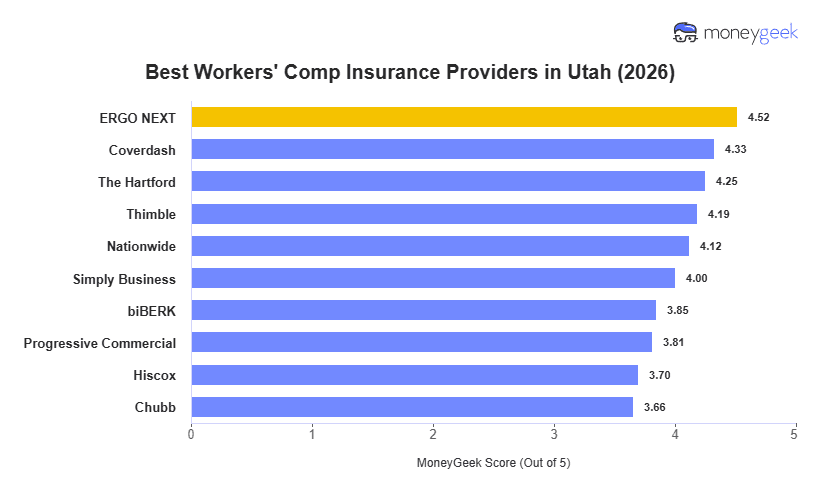
My analysis shows that ERGO NEXT is the best workers' compensation insurer in Utah. You can save up to $19 per month per employee since its average premium is 26% lower than the state benchmark. Besides savings, ERGO NEXT also gives you smooth and convenient buying and policy management experience. Purchasing coverage can take as little as 10 minutes and its app allows you to make changes to your policy without going through an agent.
Best Workers' Comp Insurance in Utah (2026)
With rates starting at $9 monthly, ERGO NEXT, Coverdash and The Hartford offer the cheapest and best workers' comp insurance in Utah.
Get matched to top Utah workers' comp insurance providers and find your ideal coverage with our tool below.
Select state
Updated: October 2, 2026
Advertising & Editorial Disclosure
Best Workers' Comp Insurance Companies in Utah
| ERGO NEXT | 4.52 | $54 | 1 | 6 |
| Coverdash | 4.33 | $66 | 5 | 1 |
| The Hartford | 4.25 | $72 | 3 | 3 |
| Thimble | 4.19 | $61 | 8 | 9 |
| Nationwide | 4.12 | $68 | 6 | 5 |
MoneyGeek analyzed workers' comp insurance rates and provider performance across Utah using small business profiles with 1 to 4 employees spanning 408 major industries. Companies earn up to five points in each category in our scoring system. We then use a weighted average of these category scores to calculate a MoneyGeek score out of five.
- Affordability (55%): Based on average payroll for the most common employee code per industry and state classification, priced per employee for a 1 to 4 employee business.
- Customer Experience (35%): Evaluates buying (20%), which covers quote access, pricing accuracy and sales support; policy management (30%), which covers payroll reporting, audits, billing and loss control; and claims (50%), which covers FNOL speed, adjuster support, medical access, wage replacement and dispute handling.
- Coverage Options (10%): Assesses coverage completeness (35%), including employers' liability and wage and medical reimbursement; policy flexibility and endorsements (25%); eligibility, state and industry breadth (20%); and policy terms, limits and exclusions (20%).

ERGO NEXT
Best Workers' Comp Insurance in Utah
MoneyGeek Rating
4.5/ 5
5/5Affordability Score
4.3/5Customer Experience Score
3.5/5Coverage Score
Average Monthly Cost
$54Claims Processing Score
4/5Policy Management Score
4.1/5Buying Process Score
4.4/5

Coverdash
Best Utah Workers' Comp Insurance: Runner-Up
MoneyGeek Rating
4.3/ 5
4.5/5Affordability Score
4/5Customer Experience Score
5/5Coverage Score
Average Monthly Cost
$66Claims Processing Score
4/5Policy Management Score
4/5Buying Process Score
4/5
Cheapest Workers' Comp Insurance Companies in Utah
ERGO NEXT offers the cheapest workers’ compensation rates in 18 of the 25 Utah industries analyzed, with its biggest pricing advantages appearing in higher-risk industries. The Hartford provides the cheapest rates in six lower-risk, office-focused industries.
ERGO NEXT's rates range from $10 per month for marketing firms to $126 for construction contractors. Thimble offers the lowest rate for other professional services at $15 per month. Businesses with less traditional classifications should compare quotes across multiple providers before choosing coverage.
| Financial Services | The Hartford | $9 | $108 |
| Beauty, Body & Wellness Services | ERGO NEXT | $10 | $120 |
| Marketing & Communications | ERGO NEXT | $10 | $120 |
| Consulting Services | The Hartford | $11 | $132 |
| Real Estate & Property Services | The Hartford | $12 | $144 |
| Other Professional Services | Thimble | $15 | $180 |
| Childcare Services | ERGO NEXT | $22 | $264 |
| Food & Beverage | ERGO NEXT | $23 | $276 |
| Tech/IT | The Hartford | $23 | $276 |
| Hospitality, Travel & Tourism | The Hartford | $25 | $300 |
| Healthcare & Medical | The Hartford | $27 | $324 |
| Retail & Product Rental | ERGO NEXT | $30 | $360 |
| Nonprofit & Associations | ERGO NEXT | $34 | $408 |
| Pet Care Services | ERGO NEXT | $34 | $408 |
| Education | ERGO NEXT | $38 | $456 |
| Fitness Services | ERGO NEXT | $38 | $456 |
| Repair & Maintenance | ERGO NEXT | $40 | $480 |
| Arts, Media & Entertainment | ERGO NEXT | $53 | $636 |
| Recreation & Sports | ERGO NEXT | $60 | $720 |
| Cleaning Services | ERGO NEXT | $62 | $744 |
| Manufacturing | ERGO NEXT | $81 | $972 |
| Agriculture & Natural Resources | ERGO NEXT | $88 | $1,056 |
| Wholesale & Distribution | ERGO NEXT | $102 | $1,224 |
| Construction & Contracting | ERGO NEXT | $126 | $1,512 |
| Transportation & Logistics | ERGO NEXT | $161 | $1,932 |
How to Get the Best Workers' Comp Insurance in Utah
Follow these steps to find workers' comp insurance that fits your Utah business best. For a full walkthrough, see our guide on how to get workers' compensation insurance.
- 1
Confirm Utah Coverage Requirements
Workers' comp requirements in Utah begin with your first employee. A corporation staffed only by its directors or officers may exclude up to five of them. Filing the proper notice is still mandatory. Instead, a solo business owner hired by another company may need a separate workers' compensation coverage waiver.
- 2
Identify Your NCCI Class Codes Accurately
Describe your business clearly instead of listing employee titles. Utah uses NCCI class codes, and the insurer needs to know what work generates your revenue. Employees who encounter different risks on the job may fall under different codes, so keep separate payroll records for workers whose duties could qualify them differently.
- 3
Document Payroll, Employee Count and Claims History
Give carriers your payroll totals by class code, along with loss runs that show previous claims. If you hire sole proprietors with no employees, confirm whether each one holds an active Workers' Compensation Coverage Waiver. Without a waiver, Utah may treat that person as your statutory employee, and their earnings could be added to your policy audit.
- 4
Request Quotes From Multiple Licensed Utah Carriers
Occupational risk sets the baseline for premiums. Each insurer's own pricing approach and your claims history then affect the final number. Compare business insurance quotes from several licensed carriers, including Utah-based WCF Insurance if it fits your operation. Ask each insurer to list the class codes and payroll assumptions behind its price, which lets you line up equivalent quotes side by side.
- 5
Compare on Quality, Not Just Price
Look at how each carrier arranges medical care after an injury. You or the insurer may direct the employee to a preferred provider for the first visit. After that, the employee can switch once to another provider who accepts workers' compensation, as long as they notify the carrier. A claims team that responds quickly makes this process far easier to follow.
- 6
Complete Purchase and Establish Payroll and Audit Reporting
Post Utah's workers' compensation notice somewhere employees can see it. Send Form 122E to your carrier within seven days of learning about any injury that requires more than first aid or results in a medical bill. Give the employee a copy of Form 100, since it spells out their rights and responsibilities.
- 7
Review at Annual Renewal
Use the payroll audit to confirm two things: that waived contractors still qualify for exclusion, and that employee wages sit under the correct NCCI codes. Report new operations before renewal instead of waiting for the insurer to find them during the audit. If Utah-based employees now work outside the state, ask about extra-territorial coverage to extend the policy to that work.
Best Workers' Compensation Insurance in Utah: Bottom Line
ERGO NEXT is the best workers' comp provider for most Utah employers. The insurer offers the state's lowest rate and earns the top overall MoneyGeek score. Small businesses that prioritize a fast digital buying experience can look to Coverdash as a reliable alternative. Employers who need deeper claims support and loss-control resources fit better with The Hartford. The right choice depends on your industry and claims history. It also depends on how much weight you place on price versus service depth.

LEARN MORE ABOUT UTAH BUSINESS INSURANCE
The best small business insurance in Utah has more than workers' comp in its mix. I've provided resources below that show our recommended insurers for other coverage types you'll likely need for your business.
Utah Workers' Compensation Insurance FAQ
ERGO NEXT is Utah's cheapest workers' comp provider at $54 a month and is also our top pick for the best workers' comp insurance in the state. The five most affordable providers are:
- ERGO NEXT: $54 a month
- Thimble: $61 a month
- Coverdash: $66 a month
- Nationwide: $68 a month
- The Hartford: $72 a month
Utah mandates workers' comp insurance for most employers with one or more employees, including part-time workers. Exemptions include sole proprietors without employees, partners and corporate officers owning 10% or more of company stock. Noncompliance results in fines up to $1,000 per employee plus daily penalties until coverage begins.
Utah's average workers' comp insurance cost is $73 a month per employee. The cheapest industry is Beauty, Body and Wellness Services at $13 a month, while the most expensive is Transportation and Logistics at $219 a month.
You can get workers' comp coverage in Utah by:
- Purchasing from private insurance companies licensed to sell workers' comp in Utah
- Buying through the Workers' Compensation Fund of Utah, the state-operated insurer
- Self-insuring if your business meets Utah's strict financial requirements and approval process
Many business owners compare quotes online or through brokers to get the best rate and compliance support.
Workers' compensation in Utah covers:
- Medical expenses are covered for work injuries, including minor cuts at Salt Lake City job sites and machinery accidents at Provo factories
- Injured employees get wage replacement benefits covering part of their income during recovery
- Permanent disability compensation applies to lasting impairments that reduce earning capacity
- Survivor benefits cover funeral costs and ongoing financial support when a workplace fatality occurs
About Angelique Palenzuela-Cruz

Angelique Palenzuela-Cruz is a Business Insurance Content Writer at MoneyGeek, where she specializes in general liability, workers’ compensation and professional liability insurance. Her work helps small business owners understand how these policies apply to coverage, including risks like customer injuries, employee injuries, professional mistakes, client contract terms and industry-specific coverage requirements.
She primarily covers service-based businesses where liability and employee coverage decisions are especially important, including cleaning, consulting, beauty and wellness, childcare, education, fitness, food service, pet care, repair and maintenance, and other professional services.
Before joining MoneyGeek, Angelique spent nearly 12 years at Guthrie-Jensen Consultants, one of Southeast Asia’s largest management training firms, where she advanced from Training Consultant to Managing Consultant. In that role, she worked with business clients to assess operational needs, develop training programs and present performance analyses to executive decision-makers. She also helped establish Gladwin Training Consultancy, where she served in learning solutions and client service roles.
Her background gives her practical context for writing about how businesses operate, manage client expectations, structure teams and make risk decisions. At MoneyGeek, she applies that experience to business insurance content, connecting coverage to actual business needs.
LinkedIn: linkedin.com/in/ma-angela-cruz
Email Contact: angelique.palenzuela@moneygeek.com