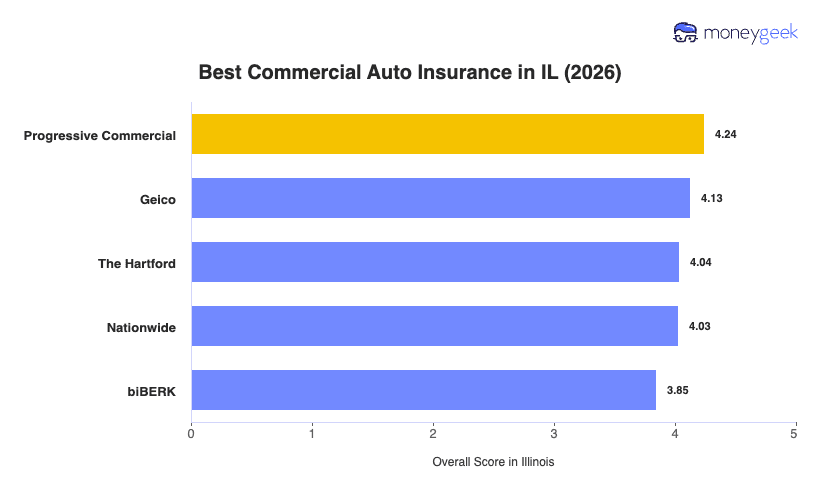

Any vehicle an Illinois business owns, leases or sends an employee to drive for work needs its own policy. Commercial auto insurance covers the liability costs, repair bills and medical expenses that follow an on-the-job accident. Personal auto policies don't extend to business use, so a claim that happens during a work trip gets denied outright, regardless of fault.
Illinois businesses across logistics, construction, agriculture and manufacturing rely on commercial auto policies to cover a range of exposures. A standard Illinois commercial auto policy can include:
- Liability coverage: Pays what the business owes others after an at-fault accident, covering bodily injuries to other drivers or passengers and property damage to vehicles or structures. Illinois sets the baseline at 25/50/20: $25,000 per person, $50,000 per accident and $20,000 in property damage. Vehicles crossing state lines or exceeding 10,001 pounds GVWR may need higher limits under federal FMCSA rules.
- Collision insurance: Covers repair or replacement costs for the business vehicle after a collision with another vehicle or object. It pays out regardless of fault, which matters in high-traffic corridors like the Chicago metro where multi-vehicle incidents are common.
- Comprehensive insurance: Covers damage to the business vehicle from non-collision events: theft, vandalism and weather. Illinois businesses that park vehicles outdoors overnight (from farm trucks in central Illinois to delivery vans in Chicago) use this coverage to cover hail damage, storm debris and theft losses.
- Uninsured/underinsured motorist coverage: Pays costs when a driver who hits the business vehicle carries no insurance or not enough to cover the full damage. Illinois requires this coverage on commercial policies and it's particularly relevant here: roughly 12% to 15% of Illinois drivers are uninsured.
- Medical payments (MedPay): Pays medical bills for the driver and passengers after an accident, regardless of fault. Illinois is an at-fault state so personal injury protection (PIP) isn't available here. MedPay is the Illinois equivalent, it's optional, and limits typically run from $1,000 to $50,000.