
Top Picks: Best Commercial Auto Insurance Companies in North Carolina

MoneyGeek analyzed North Carolina's best commercial auto insurance providers on pricing across eight vehicle types and 25 industries, along with coverage breadth and policy flexibility, and scored each carrier on customer experience across buying, managing and filing claims. Five providers stand out for North Carolina businesses.

  1. Progressive Commercial: Best Overall, Best for Fleet Operations
  2. GEICO: Best for Low-Risk Business Areas
  3. The Hartford: Best for Coverage Depth
  4. Nationwide: Best for Agricultural and Specialty Fleets
  5. biBERK: Best for Simple Coverage Needs

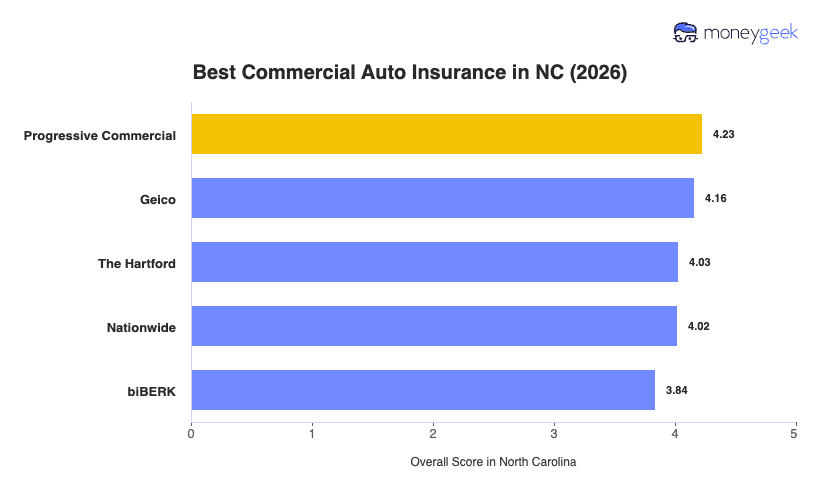
The table below sets all five providers side by side so you can see how they compare on score and rank.

Progressive Commercial4.23214
Geico4.16123
The Hartford4.03521
Nationwide4.02352
biBERK3.84445

The summaries below spell out who each provider fits best and who should look elsewhere, since the overall ranking matters far less than how well a provider matches your specific vehicle type, industry or operational need.

Progressive

Progressive

Best Overall, Best for Fleet Operations

Progressive Commercial holds the largest share of the commercial auto market in the country, and in North Carolina that scale translates into real pricing advantages across vehicle types that most carriers can't match consistently. It prices below the state average on taxis, limousines, food trucks and vans, and its customer experience score pulls away from the other four providers by a meaningful margin. That combination of competitive rates and post-purchase support makes it the most well-rounded option on this list for businesses running multiple vehicles or operating in higher-exposure categories. The one area where it gives ground is coverage depth. Its coverage score ranks fourth among the five, so if your operation needs broad endorsement options or specialized policy structures, The Hartford is worth a direct comparison. For most North Carolina fleet operators, though, Progressive Commercial is the right place to start.

Learn More: Progressive Business Insurance Review

GEICO

GEICO

Best for Low-Risk Business Areas

Part of Berkshire Hathaway's insurance group, GEICO has spent over 70 years building its reputation on competitive pricing and straightforward digital access, and that combination shows up clearly in its North Carolina commercial auto numbers. It ranks second overall and first on affordability across the five providers, posting the strongest rates on farm tractors, sedans, SUVs and pickup trucks. That vehicle mix points to who GEICO works best for, namely businesses running standard light commercial vehicles in lower-exposure categories, where its pricing advantage is sharpest and its digital-first model fits the operation. Where it gives ground is customer experience, which ranks third among the five providers, and its coverage score sits in the middle of the field. North Carolina businesses in professional services, consulting, real estate and similar low-mileage, office-based operations will find GEICO the most cost-effective option on this list.

The Hartford

The Hartford

Best for Coverage Depth
On The Hartford's site

Founded in 1810, The Hartford brings more than two centuries of commercial insurance experience to North Carolina's market, and that depth shows up most clearly in its coverage score, which leads all five providers in this analysis. It ranks first on coverage options, offering the broadest policy structures, the widest endorsement availability and the most flexibility across coverage tiers of any carrier on this list. The tradeoff is price. The Hartford ranks last on affordability overall, coming in above the North Carolina average on every vehicle type, and that gap is most pronounced on farm tractors and pickup trucks, where other providers price considerably lower. For North Carolina businesses where coverage quality and claims reliability matter more than finding the lowest rate, particularly operations in construction, healthcare or transportation where a coverage gap at claim time carries real financial consequences, The Hartford is the strongest option on this list for policy depth.

Learn More: The Hartford Business Insurance Review

Nationwide

Nationwide

Best for Agricultural and Specialty Fleets

Nationwide was founded in 1926 by the Ohio Farm Bureau Federation specifically to serve farmers who couldn't get fair coverage from traditional insurers, and that agricultural DNA is still visible in its commercial auto product nearly a century later. It ranks fourth overall in North Carolina but tells a more nuanced story than that position suggests. Its coverage score ranks second among the five providers, and its agricultural and specialty fleet infrastructure is deeper than anything else on this list. The affordability picture is mixed. Nationwide prices competitively on limousines and vans but comes in above the North Carolina average on farm tractors and pickup trucks, which is a meaningful limitation given how central those vehicle types are to the state's agricultural and construction sectors. Its customer experience score ranks last among the five providers, which is the most important caveat for any North Carolina business owner who values post-purchase support. For operations in agriculture, food processing or specialty fleet categories where coverage structure matters more than rate or service scores, Nationwide is worth a serious look.

Learn More: Nationwide Commercial Auto Insurance Review

biBerk

biBerk

Best for Simple Coverage Needs

biBERK is Berkshire Hathaway's direct-to-consumer small business insurance brand, built around one idea, which is getting covered online without a broker, an agent or a waiting room. Founded in 2015, it's the newest provider on this list and the most narrowly focused. In North Carolina it ranks fifth overall, and the data reflects its positioning accurately. Its affordability score is competitive on sedans and SUVs, two vehicle types common in low-exposure, office-based operations, but it prices above the state average on every high-exposure vehicle category including taxis, limousines and food trucks, sometimes by a wide margin. Its coverage score ranks last among the five providers, which is a real limitation for any North Carolina business with complex fleet needs or specialized risk. What biBERK does well is exactly what it's designed to do, offering a straightforward digital purchase process, Berkshire Hathaway's financial backing and A++ AM Best ratings, and a policy structure that works cleanly for small businesses that know what they need and don't require much hand-holding after purchase. For a North Carolina sole proprietor or micro-business running one or two standard vehicles in a low-risk industry, biBERK is a practical and financially sound option.

Learn More: biBerk Business Insurance Review

What Determines the Best Commercial Auto Insurance in North Carolina for You

The best commercial auto insurance in North Carolina isn't defined by a single factor. The right provider balances affordability, coverage depth and customer experience across the vehicle types and industries most common in the state. Three areas matter most when evaluating which insurer fits your business.

  • money2 icon

    Affordability Across Your Vehicle Type and Industry

    North Carolina commercial auto pricing varies more by vehicle type and industry than most businesses expect, and the gaps are wide enough to matter. Taxi and limousine operators, for example, see rate differences of 30% or more between the most and least affordable providers in this analysis. Pickup trucks and sedans, common in construction and professional services across the state, also show meaningful variation. The industry you operate in compounds the effect, so a food and beverage business and a consulting firm running identical vehicles will pay very different rates. Starting with your actual vehicle type and industry, rather than a general rate comparison, points you to the cheapest commercial auto providers in NC for your profile faster.

  • insurance2 icon

    Coverage That Matches Your Fleet's Risks

    North Carolina requires minimum liability coverage of 50/100/50, meaning $50,000 per person for bodily injury, $100,000 per accident and $50,000 for property damage, and it mandates uninsured and underinsured motorist coverage at matching limits on all new and renewed policies as of July 1, 2025. North Carolina is an at-fault state, so it has no PIP or no-fault requirement, and the driver responsible for a crash carries the liability. Those minimums are the legal floor, not a recommendation. Beyond them, evaluate each policy on:

    • Liability limits offered: State minimums set the legal floor. Construction, healthcare and transportation operations in North Carolina should confirm whether a provider's liability ceiling actually covers their worst-case claim exposure above the 50/100/50 minimum.
    • Breadth of vehicles covered: Provider eligibility rules vary. Progressive Commercial covers a wide range of commercial vehicle types, while biBERK restricts coverage for specialty and high-exposure vehicles.
    • Standard vs. endorsement coverage: Roadside assistance, rental reimbursement and gap coverage come standard with some carriers and cost extra with others. Confirm what's included before comparing premiums.
    • Hired and non-owned auto coverage: North Carolina consulting, real estate and healthcare businesses that send employees out in personal vehicles need this. It's absent by default on most base commercial auto policies.
    • Cargo and equipment protection: North Carolina's agriculture, food processing, wholesale distribution and logistics operations frequently need motor truck cargo coverage. Not every provider offers it as an endorsement.
    • Deductible flexibility: North Carolina delivery and construction fleets with high claim frequency should weigh higher deductibles against the premium savings carefully.
    • Coverage for fleet growth: Some carriers create temporary gaps when vehicles are added mid-policy. Confirm the process before committing.
  • talk icon

    Customer Experience and Claims Support

    A commercial auto policy is only as useful as the carrier behind it when something goes wrong. For North Carolina businesses, that means evaluating how each provider handles claims, including whether filing is available 24/7, how long resolution typically takes and what commercial policyholders consistently report about the process. NAIC complaint ratios offer one objective data point, and direct evaluation of each provider's policy management tools, digital access and agent availability rounds out the picture. The difference between a carrier that resolves a claim in days and one that takes weeks is a real operational cost for any business that depends on its vehicles.

How to Choose the Best Commercial Auto Insurance in NC

Choosing the right commercial auto insurance in North Carolina requires more than comparing premiums. These steps help you make the most informed decision for your business.

  1. 1
    Define Your Risk Profile

    Document every vehicle your business operates in North Carolina, including owned, leased and employee-owned vehicles used for business, along with each vehicle's primary use, annual mileage and the driving records of everyone behind the wheel. Businesses in construction, agriculture, food processing and transportation should pay particular attention to load type and mileage, since both directly affect pricing and eligibility across the five providers in this analysis.

  2. 2
    Determine Your Coverage Requirements

    With your risk profile in hand, map which coverages your operations actually require beyond North Carolina's 50/100/50 minimum and mandatory UM/UIM coverage. Businesses hauling goods need cargo coverage, financed or leased vehicles require collision and comprehensive coverage, and operations relying on employee vehicles need hired and non-owned auto coverage. Match coverage to real operational needs rather than assumptions.

  3. 3
    Research Providers by Industry and Vehicle Type

    Not every carrier prices every risk the same way in North Carolina. Some providers price high-exposure vehicles like taxis and limousines far more competitively than others, while carriers like GEICO offer stronger value for standard light commercial vehicles in lower-risk industries. Identify which carriers have demonstrated strength in your specific vehicle category and industry before comparing on price.

  4. 4
    Evaluate Coverage Quality and Policy Terms

    Comparing premiums tells you what a policy costs. Comparing policy terms tells you what you're buying. For each provider on your shortlist, check which coverages are standard versus endorsement-only, what liability limits are available above North Carolina's 50/100/50 minimum and what exclusions could affect a claim. Confirm how the policy handles mid-term fleet changes, since adding vehicles during a policy period creates temporary coverage gaps with some carriers.

  5. 5
    Get Quotes to Confirm

    Request quotes only after narrowing your options through research. North Carolina commercial auto pricing varies meaningfully by vehicle type, industry and location within the state, so a quote from a provider that doesn't specialize in your category may not reflect what you'd actually pay. Comparing quotes validates your shortlist rather than building it.

  6. 6
    Confirm North Carolina Filing Requirements

    Verify whether your operation triggers additional filing requirements before purchasing. North Carolina businesses running vehicles with a GVWR above 10,000 pounds for interstate for-hire transport must obtain a USDOT number and MC number from the FMCSA, file a BMC-91 insurance filing and designate a process agent through a BOC-3 filing. Intrastate for-hire passenger carriers and hazmat operators face separate state-level requirements under North Carolina General Statutes, so confirming these before purchase avoids coverage gaps and delays in activating your authority.

Best Commercial Auto Insurance in North Carolina: Bottom Line

Three questions cut through most of the noise when comparing commercial auto insurance in North Carolina. What vehicles does your business operate, what industry are you in, and what would a serious claim actually cost your operation? Your answers narrow the field faster than any rate comparison, because pricing and coverage depth vary more by vehicle type and industry than most North Carolina businesses expect. Start there before you look at a single quote.

From there, weigh two things. Does the cheapest policy actually cover your operation's real exposure, and do you want a fully digital self-service experience or a carrier with more hands-on agent support? Those two dimensions alone point toward different providers on this list. Once you have a shortlist based on fit, get two or three quotes to confirm whether the pricing holds for your specific fleet, location and coverage requirements in North Carolina.

Best Commercial Auto Insurance in NC Chart
mglogo icon
LOOKING FOR THE BEST INSURERS FOR OTHER COVERAGE TYPES?

Commercial auto insurance is only one piece of your best North Carolina business insurance bundle, and you'll likely need more coverage to satisfy requirements and protect your company financially. Below, explore more state-specific guides to top insurers for other commonly needed business insurance types.

How We Built These Best Commercial Auto Insurer Rankings

North Carolina's commercial auto rankings come down to three things. The first is what businesses in the state actually pay for coverage, the second is what happens when they need support, and the third is whether the policy holds up when a claim is filed. Each provider was scored across affordability (50% of the score), customer experience (30%) and coverage options (20%), weighted that way because price is where most North Carolina businesses start the search, though it's rarely where the decision should end. For the full breakdown, see the methodology.

About Mark Flores


Mark Flores, Business Insurance Writer, MoneyGeek

Mark Flores is a Business Insurance Content Writer at MoneyGeek, where he focuses on commercial auto, commercial property, cyber and specialty business insurance coverage. His work simplifies coverage terms, gives business owners a strong baseline for expected costs, and narrows down policies and providers tailored to your operation, regardless of complexity.

Before joining MoneyGeek’s business insurance team, Mark worked as a Senior Content Writer at Clutch.co, where he produced structured B2B reviews and provider analyses based on client interviews, company research and service evaluation. That experience shaped his approach to business insurance content, especially when comparing insurers, explaining coverage differences and translating complex policy features into practical guidance for small business owners.

Mark also spent nearly 4 years as a digital marketing specialist serving small-business clients across industries such as home services, manufacturing and education. That background gives him practical context for how businesses evaluate vendors, manage operational needs and make purchasing decisions.

At MoneyGeek, he applies this research and evaluation experience to build guides that help transportation sectors, those with complex property-related risks (such as hotels and retail stores), and those most at risk of a cyberattack get the coverage they need at a reasonable price.

Linkedin: https://www.linkedin.com/in/mark-jason-flores-7844634a/

Contact Email: mark.flores@moneygeek.com