



Jump to the section that meets your needs best.
Average Commercial Property Insurance Cost (2026 Report)
Average commercial property insurance costs range from $12 to $480 per month for business personal property (BPP) coverage.
Rates are driven by your property's employee count, general industry category and location.
If you're ready to get quotes, get matched to your commercial property insurer fit below.
Select state
Updated: September 8, 2026
Advertising & Editorial Disclosure
How Much Does Commercial Property Insurance Cost?
The average commercial property insurance cost is $125 per month ($1,498 per year), based on MoneyGeek's analysis across 25 general industry categories, all 50 states, plus Washington, D.C., for a 1 to 4-employee business. The rates presented are for business personal property coverage only, without building protection up to the average replacement cost for a typical company of this size nationally. What you actually pay depends on your industry, employee count, state and the provider you choose.
To estimate average commercial property insurance costs, MoneyGeek analyzed pricing estimates from 10 commercial property providers and modeled standardized premium estimates across common business profiles. These modeled results give a consistent national benchmark and show how premiums shift by employee count, industry and location.
Dataset Scope and Assumptions
Our cost modeling uses standardized inputs for comparable results across businesses.
- Providers analyzed: 10 commercial property insurance providers
- Industries covered: 25 general industry categories (408 sub-industries)
- Location: all 50 states plus Washington, D.C.
- Employee count bands: five (0 employees, 1 to 4, 5 to 9, 10 to 19, 20 to 49)
- Coverage baseline: minimum coverage commercial property policy (the market standard for benchmark comparisons)
How We Calculated Average Commercial Property Insurance Costs
MoneyGeek's published averages represent modeled premiums for standardized business profiles, aggregated two ways. Each figure isolates one variable at a time so you can see where your costs land relative to the national benchmark of $125 per month.
- National Benchmark Average: The national average reflects the modeled premium for a minimum coverage policy for a business with one to four employees across all industries and states in the dataset. This single figure gives a starting reference point before accounting for your specific business profile.
- Segment Averages: To show how costs shift, MoneyGeek calculated average modeled premiums isolated by one variable at a time, covering employee count, general industry category and state. A solo operator in a low-risk consulting firm will see a very different number than a manufacturing business with 20 or more employees.
Read our business insurance methodology for more details.
Get Commercial Property Insurance Cost Estimates
Use the commercial property insurance calculator below for an estimate tailored to your business. Enter your industry, employee count and state to see what businesses like yours typically pay.
Commercial Property Insurance Cost Estimate Calculator
Select your state and industry to view average business insurance premiums in your area. Rates are calculated based on a business with 5 employees and $500,000 in annual revenue.
Select State
Select General Industry
Select Employee Count
Average monthly rate—
Select State
Average monthly rate—
Select General Industry
Select Employee Count
What Factors Affect Commercial Property Insurance Costs?
Commercial property insurance pricing is driven by your property's physical characteristics, geographic location, general industry classification and employee count. Each one shapes how insurers estimate exposure and set your premium.
 Property Characteristics
Building value, construction material (frame vs. masonry), year built and occupancy type are the core underwriting inputs for commercial property insurance. MoneyGeek's dataset doesn't isolate these as standalone pricing variables, but a $2 million wood-frame building prices very differently from a $2 million masonry structure, even in the same city and industry.
 Geographic Location
State regulations, natural disaster exposure, local construction costs and litigation patterns all affect your rate. Monthly rates range from $109 in North Dakota to $150 in New York for comparable business profiles.
 General Industry Category
Your general industry classification reflects how physically hazardous your operations are. Rates across 25 general industry categories range from $12 per month for Real Estate & Property Services to $480 per month for Wholesale & Distribution, a spread driven by physical hazard level, inventory value, foot traffic and claim history.
 Employee Count
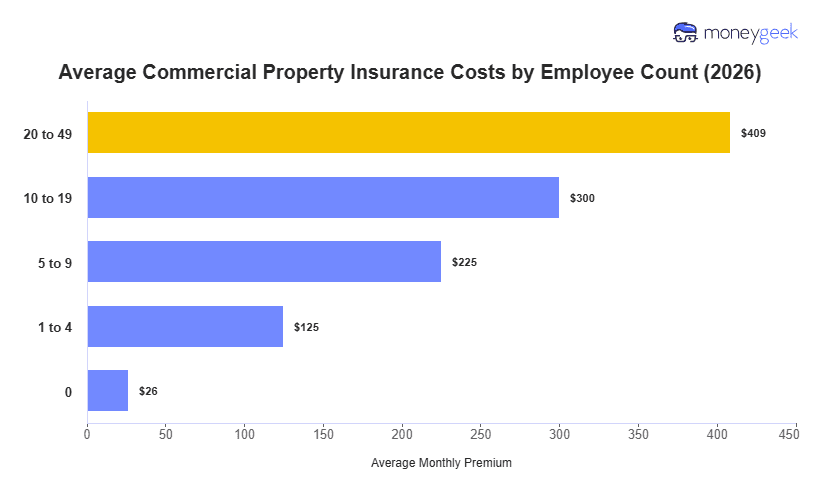
Larger workforces signal greater property exposure and higher business interruption risk. In MoneyGeek's dataset, costs scale from $26 per month for solo operators to $409 per month for businesses with 20 to 49 employees, making it the strongest pricing signal in our data, though property characteristics and location carry more weight in real underwriting.
How to Lower Commercial Property Insurance Costs Without Sacrificing Coverage
Your biggest cost levers for commercial property insurance are the variables insurers price most heavily, starting with your property's characteristics, your industry and your employee count. Some adjustments take effect at your next renewal, while others compound over time. Learn more about getting cheap commercial property policies below that fit your needs.
Quick Commercial Property Cost-Lowering Methods
These are the fastest ways to reduce what you pay without changing your coverage.
 Provide Accurate Underwriting Information From the Start
Employee count, business square footage, property value, construction type and occupancy use all feed into your rate. Vague or underestimated answers push underwriters toward worst-case assumptions. Accurate inputs from day one often produce lower premiums than a mid-term correction.
 Compare Quotes Using Identical Coverage Terms
A lower monthly quote means nothing if the policy carries a lower building replacement value limit or excludes business personal property. Compare quotes across at least three providers using matching coverage limits, deductibles and endorsements before choosing based on price.
- Bundle Commercial Property With Your General Liability or BOP Policy
Standalone property buyers can often access multi-policy discounts by combining with general liability. Ask for a bundled quote before comparing standalone rates.
 Pay Annually Instead of Monthly
Annual payments eliminate installment fees and often carry a small discount. This saves roughly 5% to 10% compared to monthly payment plans.
 Raise Your Deductible if You Have Cash Reserves
Increasing your property deductible from $500 to $1,000 or $2,500 can reduce your property premium by 10% to 25%. This works best for businesses with clean claims histories and enough cash reserves to cover the higher out-of-pocket cost after an incident.
Long-Term Commercial Property Cost-Lowering Methods
These strategies take one to two renewal cycles to show up in your rate, but they compound over time.
Commercial Property Insurance Cost: Bottom Line
What you actually pay for commercial property insurance depends almost entirely on your business profile. Before comparing quotes, get clear on three things.
- What does your business actually look like? General industry category and employee count are the two strongest pricing signals in MoneyGeek's data. A solo consultant and a 30-person manufacturing operation start from very different baselines, even in the same state.
- What is your property actually worth to replace? Replacement cost is the foundation of the entire policy. A business that doesn't know its building's reconstruction value going in will either be underinsured or overpaying. Get an accurate replacement cost estimate before shopping, because it determines the coverage limit, which drives the premium more than almost anything else.
- What's your timeline? Some cost levers work immediately, including accurate underwriting details, bundling, annual payment and deductible adjustment. Others, like building a clean loss history or completing a risk mitigation improvement, take one to two renewal cycles to show up in the rate.
Getting commercial property insurance right is less about finding the cheapest rate and more about matching coverage to what the property is actually worth and what the business would lose if it were damaged or destroyed.
If You Want to Learn About Costs From Other Coverage Types
Commercial property is rarely the only coverage your business needs. Knowing what other policies cost helps with budgeting and spotting bundling opportunities.
About Mark Flores

Mark Flores is a Business Insurance Content Writer at MoneyGeek, where he focuses on commercial auto, commercial property, cyber and specialty business insurance coverage. His work simplifies coverage terms, gives business owners a strong baseline for expected costs, and narrows down policies and providers tailored to your operation, regardless of complexity.
Before joining MoneyGeek’s business insurance team, Mark worked as a Senior Content Writer at Clutch.co, where he produced structured B2B reviews and provider analyses based on client interviews, company research and service evaluation. That experience shaped his approach to business insurance content, especially when comparing insurers, explaining coverage differences and translating complex policy features into practical guidance for small business owners.
Mark also spent nearly 4 years as a digital marketing specialist serving small-business clients across industries such as home services, manufacturing and education. That background gives him practical context for how businesses evaluate vendors, manage operational needs and make purchasing decisions.
At MoneyGeek, he applies this research and evaluation experience to build guides that help transportation sectors, those with complex property-related risks (such as hotels and retail stores), and those most at risk of a cyberattack get the coverage they need at a reasonable price.
Linkedin: https://www.linkedin.com/in/mark-jason-flores-7844634a/
Contact Email: mark.flores@moneygeek.com