
Estimate Average Business Insurance Costs for Your Life Coaching Company

Plug in your coverage type, state, employee count and vehicle type (if you need commercial auto coverage) to get a cost estimate built around your operation. No personal information is required, and workers' comp estimates are calculated per employee.

Select Coverage Type
Select State
Select Employee Count
Select Vehicle Type
Monthly Rate Estimate—

How Much Does Life Coaching Business Insurance Cost?

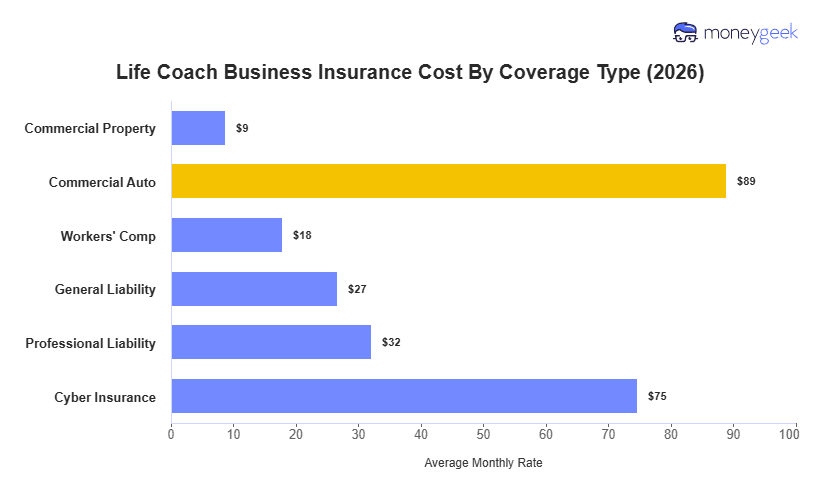
Consulting business insurance costs vary across practice types, and for life coaching businesses specifically, the average runs $41 monthly or $498 annually across six common coverage types. For most coaches, the more relevant starting point is professional liability and general liability combined, averaging around $59 monthly based on our data. What moves your number is how you work with clients: a virtual-only practice carries almost no physical liability exposure, while coaches who meet clients in a leased office or rented venue take on third-party injury risk that insurers price accordingly.

Commercial property sits at the low end at $9 per month, which fits a practice built around conversation rather than equipment or inventory. Cyber comes in at $75 monthly, the sharpest outlier in our analysis, given the sensitivity of what clients share through intake forms and session records. Commercial auto is highest at $89 monthly and matters primarily if you use your personal vehicle to travel to corporate clients or retreat venues, since personal auto policies generally don't cover business use.

The table below shows average monthly premiums for each coverage type:

Commercial Property$9$10493%6
Workers' Comp$18$21584%42
General Liability$27$320-78%22
Professional Liability$32$38144%28
Cyber Insurance$75$89510%203
Commercial Auto$89$1,06746%15

We analyzed quote data from major U.S. commercial insurance providers and modeled standardized premium estimates across business profiles representing around 95% of the market. Results are designed to provide a consistent national benchmark showing how premiums vary by key baseline factors including business size, location and vehicle type for operations that use commercial vehicles.

Dataset Scope and Assumptions

Our cost modeling uses standardized inputs for consistent comparisons across businesses.

  • Total estimates modeled: just over 6 million standardized pricing estimates
  • Providers analyzed: 10 major insurance providers
  • Geography: all U.S. states including Washington, D.C.
  • Employee count bands: solo practitioners, one to four, five to nine, 10 to 19, and 20 to 49 employees
  • Vehicle types studied: Sedans, SUVs, pickup trucks, vans, taxis, limousines, tractors, food trucks, semi-trucks (non-HAZMAT and HAZMAT), tanker trucks (non-HAZMAT and HAZMAT), buses, box trucks, dump trucks, flatbed trucks
  • Policies studied: general liability, workers' comp, professional liability, commercial auto, commercial property, and cyber insurance
    • General liability: $1 million per occurrence and $2 million aggregate
    • Workers' comp: state required coverage
    • Professional liability: $1 million per claim and $1 million aggregate
    • Commercial auto: minimum coverage
    • Commercial property: personal property coverage limits personalized to industry, business size and state
    • Cyber insurance: $1 million per occurrence and $1 million aggregate

How We Calculated Average Life Coaching Business Insurance Costs

Our published averages represent modeled premiums for standardized business profiles and were aggregated in two ways.

  • National benchmark average: The national average cost reflects the modeled premium for a standardized one to four employee business across all life coaching profession categories and states included in our dataset for a standard professional liability policy
  • Segment averages: To show how costs vary, we calculated average modeled premiums for our national base profile and isolated for variables, including:
    • Employee count (business size ranges)
    • Profession / industry categories
    • Vehicle types (for commercial auto)
    • States (including Washington, D.C.)

Segment averages were produced by aggregating modeled pricing trends across the full dataset so readers can compare how premiums shift across profession types and regions.
See our full business insurance methodology.

How Much Does Professional Liability Insurance Cost for Life Coaching Businesses?

Life coaches are mostly unlicensed, and because of this, a client who disputes a program outcome, feels harmed by your methods or believes you crossed into therapy can file a civil claim against you. No licensing board stands between them and a lawsuit. Professional liability pays your legal defense and any settlement, making it the core policy for a practice built on advice and personal growth.

Coaches in New York and Washington, D.C. spend around $37 monthly, but if you're in in Maine, North Carolina and North Dakota expect to spend an average of $28, a 36% difference tied to how often professional claims go to court in each state. Before you build up a claims history, where you practice is often the biggest factor in how much your professional liability costs.

Alabama$31$372
Alaska$29$342
Arizona$30$361
Arkansas$30$361
California$35$426
Colorado$31$376
Connecticut$35$414
Delaware$34$407
Florida$34$410
Georgia$32$388
Hawaii$33$395
Idaho$30$361
Illinois$35$418
Indiana$31$369
Iowa$30$361
Kansas$31$369
Kentucky$29$353
Louisiana$36$429
Maine$28$331
Maryland$30$361
Massachusetts$33$399
Michigan$30$357
Minnesota$30$357
Mississippi$32$380
Missouri$31$376
Montana$31$376
Nebraska$30$357
Nevada$36$433
New Hampshire$31$376
New Jersey$36$429
New Mexico$32$384
New York$37$441
North Carolina$28$331
North Dakota$28$331
Ohio$29$353
Oklahoma$30$357
Oregon$29$353
Pennsylvania$36$437
Rhode Island$35$418
South Carolina$33$391
South Dakota$30$357
Tennessee$31$369
Texas$32$384
Utah$30$361
Vermont$30$365
Virginia$29$346
Washington$36$433
Washington DC$37$448
West Virginia$33$399
Wisconsin$31$372
Wyoming$29$353

How Much Does General Liability Insurance Cost for Life Coaching Businesses?

General liability applies when someone is physically hurt or their property is damaged because of your business. For a life coach, that means a client who trips in your office, a participant who falls at a rented retreat space or equipment damaged during your workshop. It's also what landlords and co-working spaces require before letting you use their space.

General liability costs in West Virginia, Mississippi and South Dakota average $24 monthly, while estimates in California are 23% higher at $30. Your practice is built around conversation rather than a worksite, so insurers have less exposure to price. How often you rent space and whether you host group events matters more than your state.

Alabama$25$297
Alaska$29$345
Arizona$27$326
Arkansas$24$293
California$30$354
Colorado$28$341
Connecticut$29$345
Georgia$27$320
Delaware$28$331
District of Columbia$29$353
Florida$28$338
Hawaii$29$350
Idaho$25$296
Illinois$28$340
Indiana$26$308
Iowa$25$297
Kansas$25$303
Kentucky$25$301
Louisiana$25$305
Maine$26$311
Maryland$29$344
Massachusetts$29$349
Michigan$26$316
Minnesota$28$333
Mississippi$24$289
Missouri$26$307
Montana$25$298
Nebraska$25$304
Nevada$28$333
New Hampshire$28$333
New Jersey$29$346
New Mexico$25$298
New York$29$352
North Carolina$26$315
North Dakota$25$300
Ohio$26$312
Oklahoma$25$300
Oregon$28$337
Pennsylvania$27$329
Rhode Island$28$333
South Carolina$25$298
South Dakota$24$293
Tennessee$26$312
Texas$27$323
Utah$26$311
Vermont$27$324
Virginia$28$336
Washington$29$346
West Virginia$24$287
Wisconsin$26$311
Wyoming$25$298

How Much Does Cyber Insurance Cost for Life Coaching Businesses

The data you collect during your sessions is more sensitive than what most small businesses handle. Your intake forms ask clients about emotional struggles, relationship problems, health issues and financial stress, and your notes capture those details in full and sits in your scheduling apps, practice tools or cloud storage. A breach can trigger client notification costs, civil claims and lasting damage to your reputation. Cyber insurance covers those costs.

If you're based in Washington D.C. expect to pay the most per month at $92, but if you're based in Alaska, Montana and Wyoming, you'll spend around $63 for coverage. D.C., New York and California define protected information more broadly than most states, making it more likely to include the personal and emotional data your intake process collects. If you practice in those states, that compliance layer gets priced into your cyber insurance premiums whether or not a breach occurs.

Alabama$72$866
Alaska$63$760
Arizona$76$908
Arkansas$68$820
California$88$1,053
Colorado$81$967
Connecticut$85$1,022
Delaware$83$993
District of Columbia$92$1,108
Florida$81$969
Georgia$79$952
Hawaii$67$804
Idaho$64$777
Illinois$85$1,019
Indiana$74$892
Iowa$67$803
Kansas$71$848
Kentucky$72$866
Louisiana$72$866
Maine$67$806
Maryland$85$1,022
Massachusetts$85$1,019
Michigan$76$910
Minnesota$76$910
Mississippi$68$820
Missouri$74$892
Montana$63$760
Nebraska$67$803
Nevada$83$993
New Hampshire$67$806
New Jersey$86$1,035
New Mexico$69$823
New York$90$1,081
North Carolina$78$933
North Dakota$63$760
Ohio$76$907
Oklahoma$71$849
Oregon$78$934
Pennsylvania$78$935
Rhode Island$67$803
South Carolina$72$866
South Dakota$64$777
Tennessee$74$892
Texas$81$967
Utah$70$846
Vermont$67$806
Virginia$83$993
Washington$83$993
West Virginia$65$779
Wisconsin$74$889
Wyoming$63$762

How Much Does Workers’ Comp Insurance Cost for Life Coaching Businesses?

Most life coaching practices are solo operations, so workers' comp may not apply right away, but that changes the moment you hire an associate coach, a virtual assistant or any other staff. Most states require coverage immediately, and a few impose personal liability on owners who don't carry it.

Workers' comp costs California run about $32 monthly per employee, more than double the average in Utah and Texas at $15, a 115% gap driven by state-mandated rates and higher wage bases. If you are bringing on your first associate in California, that difference is significant enough to affect how you structure the engagement. Whether you classify someone as an employee or contractor carries different workers' comp obligations there than in most other states.

Alabama$16$187
Alaska$22$260
Arizona$16$189
Arkansas$16$190
California$32$380
Colorado$17$201
Connecticut$25$295
Delaware$18$220
District of Columbia$28$337
Florida$17$203
Georgia$17$198
Hawaii$19$232
Idaho$16$193
Illinois$18$221
Indiana$15$184
Iowa$16$190
Kansas$16$190
Kentucky$16$196
Louisiana$18$212
Maine$17$208
Maryland$17$204
Massachusetts$22$267
Michigan$18$213
Minnesota$17$206
Mississippi$17$204
Missouri$17$200
Montana$17$205
Nebraska$15$185
Nevada$17$203
New Hampshire$17$203
New Jersey$23$282
New Mexico$17$204
New York$21$255
North Carolina$16$194
Oklahoma$17$206
Oregon$17$208
Pennsylvania$19$223
Rhode Island$18$220
South Carolina$17$209
South Dakota$16$188
Tennessee$16$187
Texas$15$180
Utah$15$177
Vermont$17$207
Virginia$15$182
West Virginia$18$214
Wisconsin$17$203

How Much Does Commercial Property Insurance Cost for Life Coaching Businesses?

Commercial property covers the physical assets your practice depends on: your laptop, monitor, office furniture and any coaching or recording equipment. For most life coaches, that list is short and if you run a virtual-only practice, you might skip it, though replacing your laptop and peripheral gear after a theft adds up faster than the premium might suggest.

North Dakota, South Dakota and Nebraska average $8 monthly, while in New York, the most expensive state, you'll only pay $2 more. That gap is smaller than the premium difference between a $500 and $1,000 deductible on the same policy, so your deductible choice has more financial impact than your state.

Alabama$8$97
Alaska$10$115
Arizona$9$104
Arkansas$8$94
California$10$120
Colorado$9$108
Connecticut$10$118
Delaware$9$111
District of Columbia$10$123
Florida$10$118
Georgia$9$104
Hawaii$10$122
Idaho$8$99
Illinois$9$107
Indiana$8$96
Iowa$8$93
Kansas$8$93
Kentucky$8$96
Louisiana$9$108
Maine$8$100
Maryland$9$114
Massachusetts$10$120
Michigan$8$99
Minnesota$8$102
Mississippi$8$95
Missouri$8$95
Montana$8$96
Nebraska$8$92
Nevada$9$106
New Hampshire$9$104
New Jersey$10$122
New Mexico$8$97
New York$11$126
North Carolina$9$104
North Dakota$8$91
Ohio$8$99
Oklahoma$8$95
Oregon$9$109
Pennsylvania$9$112
Rhode Island$10$115
South Carolina$9$102
South Dakota$8$92
Tennessee$8$99
Texas$9$110
Utah$8$102
Vermont$8$101
Virginia$9$106
Washington$9$112
West Virginia$8$94
Wisconsin$8$98
Wyoming$8$94

How Much Does Commercial Auto Insurance Cost for Life Coaching Businesses?

When you drive to a corporate client's office, a retreat venue or an off-site workshop, your personal auto policy most likely does not cover you. Personal policies exclude business use, and an at-fault accident en route to a client could leave you paying legal costs out of pocket. Commercial auto closes that gap.

Commercial auto costs range from $33 monthly in Iowa, Vermont and Idaho to $55 in Michigan, 67% higher, driven by Michigan's no-fault system. California and Washington, D.C. also run above the $42 industry average. Most state variation reflects insurance regulation rather than how you use your vehicle, which means your usage pattern and frequency matter more to your quote than where you're located.

Alabama
$38
$454
Alaska
$50
$599
Arizona
$40
$477
Arkansas
$38
$455
California
$51
$613
Colorado
$43
$511
Connecticut
$48
$574
Delaware
$41
$491
Florida
$49
$593
Georgia
$41
$499
Hawaii
$34
$412
Idaho
$33
$400
Illinois
$46
$549
Indiana
$40
$476
Iowa
$33
$395
Kansas
$38
$457
Kentucky
$39
$473
Louisiana
$43
$516
Maine
$41
$492
Maryland
$46
$558
Massachusetts
$48
$575
Michigan
$55
$656
Minnesota
$41
$495
Mississippi
$39
$463
Missouri
$43
$516
Montana
$36
$433
Nebraska
$36
$437
Nevada
$44
$523
New Hampshire
$36
$430
New Jersey
$49
$592
New Mexico
$37
$440
New York
$51
$609
North Carolina
$41
$489
North Dakota
$38
$461
Ohio
$45
$540
Oklahoma
$38
$460
Oregon
$41
$495
Pennsylvania
$36
$428
Rhode Island
$45
$536
South Carolina
$41
$488
South Dakota
$40
$482
Tennessee
$39
$468
Texas
$47
$568
Utah
$38
$459
Vermont
$33
$398
Virginia
$43
$516
Washington
$48
$578
Washington D.C.
$53
$637
West Virginia
$39
$465
Wisconsin
$37
$442
Wyoming
$40
$484

Factors Affecting Life Coaching Business Insurance Costs

Consulting business insurance costs are shaped more by the nature of client relationships than by physical exposure. For life coaches specifically, that means what clients share with you, how that information is documented and how your practice is structured around that work are the primary drivers of what you pay.

These factors account for most of the variation in your premiums:

    laptop icon
    Session Format

    If you have a fully virtual practice, you carry almost no third-party injury risk, but if you meet clients in a leased office, co-working space or rented venue, you take on premises-related exposure that insurers factor directly into your pricing. The shift from virtual to in-person can meaningfully change what you pay.

    signupBonus icon
    Client Data Practices

    If you collect detailed intake forms and store session notes capturing emotional history, health disclosures and relationship details, insurers place you in a higher data breach risk tier than coaches with minimal digital documentation. How much your clients share with you, and how you store it, matters.

    talk icon
    Program and Service Scope

    Running group programs, multi-day retreats or workshops exposes you to a broader range of claims than one-on-one sessions. In a group setting, personal disclosures happen in front of other participants, disputes over outcomes affect multiple clients at once and third-party injury risk increases with the size of the gathering.

    businessOwner icon
    Client Type

    If your roster includes corporate clients, your insurance requirements shift considerably. Businesses frequently make minimum coverage limits a condition of engagement, request certificates of insurance before your first session and are more likely than individual clients to pursue formal claims when a program's outcomes fall short of what was promised.

    money2 icon
    Revenue and Practice Scale

    Your practice size affects more than just payroll-based coverage calculations. A solo coach with a handful of clients carries far less aggregate exposure than a practice running multiple coaches, group programs and a full client roster, and insurers price that difference into your premiums accordingly.

How to Lower Life Coaching Business Insurance Costs

As a life coach, your coverage mix spans multiple policy types, and the levers for finding affordable business insurance don't all work on the same timeline. Some take effect at your next renewal, while others require building a track record that insurers reward over time. Knowing which is which helps you act on the right ones first.

These methods offer the most meaningful cost levers available to you as a life coach:

    vsDocuments icon
    Compare quotes using the same coverage limits

    When you request business insurance quotes from multiple insurers, the limits you specify determine what you're actually comparing. If one quote is built on a $1 million per-occurrence limit and another on $2 million, the price difference reflects coverage, not insurer pricing. Requesting quotes at the same limits across every provider gives you a comparison you can actually act on.

    uninsured icon
    Right-size your coverage

    If your practice is fully virtual with no employees and no rented space, you likely don't need the same property or liability limits as a coach running in-person retreats at hired venues. Reviewing your actual operations annually and adjusting lines that no longer reflect how you work is one of the more direct ways to cut costs.

    money2 icon
    Increase your deductible strategically

    If your practice is primarily virtual and you carry commercial property or general liability with a low deductible, you are paying for claim frequency that may never materialize. Raising your deductible on lines where your actual exposure is low can reduce your premium meaningfully, provided you can cover the higher out-of-pocket cost if a claim occurs.

    shoppingBag icon
    Bundle policies with the same provider

    If you carry professional liability, general liability and cyber insurance, placing all three with the same insurer is worth exploring. Many providers offer meaningful multi-policy discounts, and consolidating your coverage simplifies renewal management and makes it easier to produce certificates of insurance quickly when corporate clients or venues request them.

    stackOfBooks icon
    Invest in risk management practices

    Insurers price your life coach business insurance partly on claim frequency signals, and demonstrating structured risk management at renewal can work in your favor over time. Building consistent habits around how you document client work, store sensitive data and set expectations up front reduces your exposure across the coverages that matter most for this work.

    • Use a written service agreement for every client that defines your program scope, what outcomes are not guaranteed and how disputes are handled.
    • Store session notes in a consistent format on a password-protected or encrypted platform, not in personal email, shared drives or unprotected cloud folders.
    • Send clients a post-program summary at the close of each engagement to document what was covered and reduce the risk of disputed outcome claims.
    • Review annually who has access to your client data, which platforms store it and whether inactive third-party tools still hold client information.

Life Coaching Business Insurance Cost: Bottom Line

Life coaching businesses average $41 per month across six coverage types, though your rate shifts based on how you work with clients and what data you hold. Use these questions to read your quotes in context:

  1. Where do you fall in the distribution? Locate your practice against the per-coverage benchmarks using session format, employee count and state. A virtual solo practice tends to fall below the property and liability averages, while a coach running group retreats will often land above them.
  2. Is your quote consistent with your risk profile? If your quote sits above the benchmarks, consider whether in-person sessions, detailed intake data or corporate clients apply to your practice, since each raises your risk profile. A lower quote may signal thinner coverage than your work requires.
  3. Which cost drivers apply to your business? A virtual coach working one-on-one faces a different cost structure than one running retreats with corporate clients. Identify which drivers reflect your actual operation before drawing conclusions from the overall average.

The gap between a benchmark and your quote traces back to a small number of factors specific to how your practice operates. Use the figures on this page as a starting point to understand what drives your number, not as a prediction of what your quote will be.

Life Coaching Business Insurance Cost: Next Steps

If you're still working out which coverage types apply to your practice, that's worth resolving before focusing on cost. A virtual-only coach carries different exposures than one running in-person sessions or retreats, and the right mix follows from how your practice operates.

If you're ready to move forward, compare quotes across providers at consistent coverage limits. Describing your practice accurately using the factors on this page helps you get quotes that reflect your actual profile rather than a generic assumption.

We also answered some frequently asked questions life coaches ask when exploring cost estimates:

What if I want to understand my coverage options before committing to a cost?

Should I have insurance if I'm only coaching part-time or just starting out?

What if I'm not sure whether cyber insurance is necessary for my practice?

What am I exposed to if a client disputes my program's outcome and I don't have professional liability?

About Connor Bolton


Connor Bolton headshot

Connor Bolton is Senior SEO and Content Manager at MoneyGeek, where he leads the business and pet insurance editorial teams. As editorial lead for both verticals, Connor sets the research framework, data standards, and content structure that his writers execute, directly authoring in-depth guides himself and reviewing all team content for accuracy and practical value before it goes live. With over four years evaluating insurance products across personal, commercial, and specialty lines, he brings cross-vertical knowledge to every guide the team produces.

Connor architected MoneyGeek's insurance research infrastructure across all major verticals including auto, home, renters, life, health, business, and pet, building systems for pricing analysis, provider-level research, customer experience evaluation, and coverage analysis with AI support. The infrastructure includes over 6 million data points for business insurance across 408 industry areas, all 50 states, and 16 vehicle types, and over 5 million pet insurance profiles across 18 major providers and hundreds of breed and age combinations. Connor's insurance cost research and his team's work has been cited by the U.S. Chamber of Commerce, Allstate, Liberty Mutual, CBS News, Forbes and LegalZoom.

Beyond the data, Connor stays connected to how the market actually operates, drawing on direct conversations with underwriters and carrier liaisons at Ethos, The Hartford, NEXT Insurance, Nationwide, and State Farm, and monitoring business and pet owner communities including Reddit, to inform how he interprets findings and frames guidance for real buyers.

He is the direct editorial contact for methodology questions at connor@moneygeek.com and can be found on LinkedIn.