
Key Takeaways
blueCheck icon

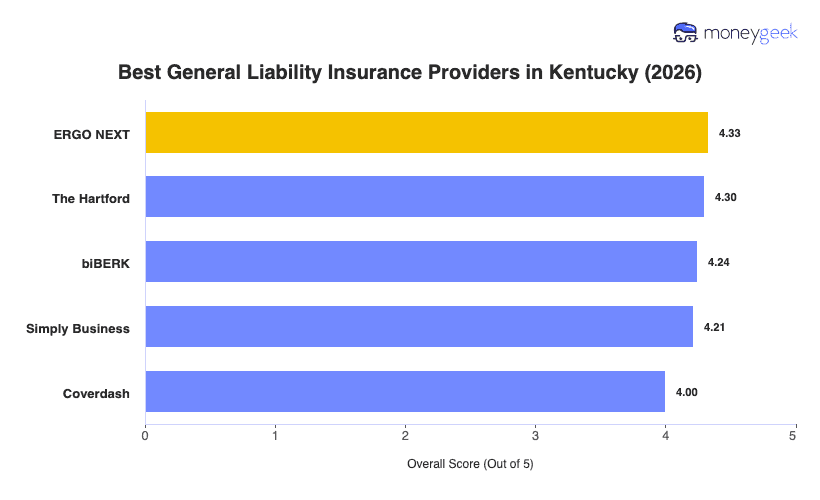
The best general liability insurance provider in Kentucky is ERGO NEXT, with top scores for both affordability and customer experience.

blueCheck icon

The Hartford offers the cheapest general liability insurance in Kentucky at $86 per month, saving businesses $15 monthly (15%).

blueCheck icon

The best general liability insurer offers rate stability, responsive service and flexible coverage, so choose a provider that performs consistently across all three areas.

Best General Liability Insurance Companies for Small Businesses in Kentucky

Finding the right general liability coverage in Kentucky for your business means looking beyond price. We gathered quotes with standard $1 million per occurrence/$2 million aggregate limits from 10 major insurers across 25 general industries, identifying the five providers that perform well for small businesses:

  1. ERGO NEXT: Best Overall, Best for Hands-On and Service Industries
  2. The Hartford: Best Cheap General Liability Insurance
  3. biBerk: Best for Consumer Service Businesses
  4. Simply Business: Best for Comparing Multiple Carriers
  5. Coverdash: Best for Higher-Risk or Non-Standard Businesses

The table below shows how each provider ranks on price and overall score across Kentucky. A bourbon distillery in Bardstown and an equine veterinary practice in Lexington will likely land on different providers, so use the rankings as your starting point to find the best fit for what your business actually does.


ERGO NEXT4.33$8918
The Hartford4.3$8682
biBERK4.24$9347
Simply Business4.21$9924
Coverdash4$10592
Thimble3.99$95610
Progressive Commercial3.91$10879
Hiscox3.86$11436
Chubb3.85$11551
Nationwide3.79$114105

For our Kentucky general liability insurance ratings, we analyzed pricing, coverage options and customer experience across 408 industries statewide. Our analysis focuses on one-to-four-person businesses, which represent a large share of Kentucky's small business market, while weighting results for broader industry and location representation across the state's commercial centers and rural service areas, including Louisville, Lexington, Bowling Green, Owensboro and the state's agricultural, coal-producing and rural trade communities.

To do this, we evaluated over 20,000 business profiles, more than 1,300 customer experience data points and reviewed coverage contracts and endorsements to compare how insurers serve Kentucky businesses consistently across different industries and regions. We then rated each company across categories of affordability (50%), customer experience (30%) and coverage options and terms (20%) to form an overall rating. For a detailed breakdown of the metrics, scoring methodology and pricing analysis specific to Kentucky, see our full methodology.

95%
% of Small Businesses Covered
Over 20,000
Business Profiles Studied
1,346
Customer Experiences Analyzed

Find the Best General Liability Insurer for Your Kentucky Business

Select your industry and state to get a customized quote from your best general liability insurer match in KY.

Industry
State

Answer 2 questions and see your top insurer in seconds. 100% free.

Company Image
Best Overall, Best for Hands-On and Service Industries

ERGO NEXT

ERGO NEXT ranks first overall in our general liability study in Kentucky, with a top-ranked buying experience and competitive rates. The buying process is fully digital, with instant quotes and certificates of insurance issued on demand, giving Kentucky businesses in areas with limited local agent access a quicker way to get covered. 

Policy management works well for businesses that handle COIs frequently or prefer self-service account tools, though reviews call out longer resolution times and less responsive communication.

This provider has the second-lowest general liability premiums on average. Businesses in hospitality, repair and maintenance, construction and manufacturing see the most savings, with rates running 26% to 37% below average. 

Policies cap at standard limits ($1 million/$2 million), though an umbrella option extends these. ERGO NEXT doesn't offer a liquor liability endorsement, and its rented premises sublimit tops out at $100,000.

Where ERGO NEXT performs best:

  • Trades, contractors and hospitality businesses where savings in Kentucky are highest
  • Solo operators and micro-businesses that need fast, low-friction coverage
  • Digital-first buyers who manage policies and COIs without agent involvement

Where ERGO NEXT performs less competitively:

  • Higher-risk operations where claims resolution quality is a deciding factor
  • Businesses that need umbrella coverage or liquor liability beyond the base GL policy
  • Mid-sized Kentucky businesses seeking low-cost coverage

Learn More: ERGO NEXT Review

Company Image
Best Cheap General Liability Insurance

The Hartford

The second-best general liability carrier for Kentucky small businesses is The Hartford, where you can get flexible coverage options for affordable premiums. Industries that see the biggest savings include health care & medical (31%), education (27%) and financial services (20%). It also has the cheapest rates for businesses with employees, regardless if you only have one or a team of 49.

The Hartford carries umbrella access, liquor liability, EPLI and cyber liability, plus a $1 million rented premises sublimit. Its policies also have higher core limits, with per occurrence limits up to $2 million and aggregate limits up to $4 million. 

Reviews on Trustpilot and Reddit regularly flag agent-dependent quoting that results in a slower buying process than digital competitors. Once you have a policy, the experience improves, with responsive agents and flexible billing. Users also rate claims handling high for fair outcomes and clear adjuster communication throughout.

Where The Hartford performs best:

  • Health care, education and financial services businesses in Kentucky that prioritize affordability
  • Growing to mid-sized operations (five to 49 employees)
  • Businesses that prioritize claims quality and ongoing policy support over digital speed
  • Operations in leased commercial spaces that need higher rented premises coverage limits

Where The Hartford performs less competitively:

  • Digital-first buyers who need instant quotes without agent involvement
  • Hands-on or physical-risk industries that seek low-cost coverage

Learn More: The Hartford Review

Company Image
Best for Consumer Service Businesses

biBerk

biBerk ranks third and offers a direct-to-consumer digital platform with no broker involvement and fast quote turnaround. Treat early estimates as a starting point when comparing providers, since some policyholders report differences between initial quotes and final billed amounts. 

The post-purchase experience is more limited. Updated certificates, midterm policy changes and online account management tend to move slower and offer fewer options.

biBerk prices most competitively for consumer-facing service businesses: cleaning (20% savings), fitness (21% savings), real estate (20% savings) and recreation (17% savings). Coverage is standard but narrow. 

Berkshire Hathaway’s underwriting backing adds financial stability, but biBerk doesn’t offer umbrella insurance, liquor liability, EPLI or cyber endorsements. These gaps make it a more limiting choice as exposure or complexity grows.

Where biBerk performs best:

  • Cleaning, fitness and recreation businesses in Kentucky that want considerable savings
  • Solo operators who prioritize direct digital buying without broker involvement
  • Low-complexity businesses that rarely need midterm policy changes or COIs
  • Buyers who value carrier financial strength over coverage customization

Where biBerk performs less competitively:

  • Businesses that need frequent COI updates, endorsements or self-service account tools
  • Construction, agriculture or wholesale operations in Kentucky that seek affordable premiums
  • Higher-exposure businesses that need umbrella, liquor liability or cyber coverage

Learn More: biBerk Review

Company Image
Best for Comparing Multiple Carriers

Simply Business

Ranking fourth overall in Kentucky, Simply Business is an aggregator. Enter your business details once and get quotes from multiple carriers side by side, including Hiscox, Markel and Travelers, which makes price comparison faster. Because each quote comes from a different carrier, exclusions and sublimits vary. 

Verified Trustpilot reviews cite confusion about what's actually included in a selected policy. After purchase, policy management and claims handling depend entirely on whichever carrier you chose.

The multi-carrier model gives small business owners access to broader endorsement options. Some carriers in the network offer liquor liability, cyber and EPLI, though availability varies by provider and requires active comparison rather than being a guaranteed option. 

Simply Business saves tech and IT businesses 23% and retail businesses 22%, with smaller savings in childcare and beauty services.

Where Simply Business performs best:

  • Tech and retail businesses in Kentucky that want lower premiums
  • Buyers who prefer to compare multiple carrier quotes in one place
  • Businesses with clear coverage needs that want a faster comparison process
  • Operations that may require endorsements not available from a single carrier

Where Simply Business performs less competitively:

  • Buyers who need clear and consistent coverage details before committing
  • Construction, marketing and nonprofit businesses where pricing is less competitive
  • Businesses that prefer a single carrier relationship for policy management and claims support

Learn More: Simply Business Review

Company Image
Best for Higher-Risk or Non-Standard Businesses

Coverdash

Coverdash, another provider with a marketplace model, ranks fifth overall in our general liability study in Kentucky. It ranks second in coverage because it provides multi-carrier access and a carrier network that includes specialty and surplus lines providers. That gives access to Kentucky businesses in harder-to-place risk categories that standard insurers may turn away. Cyber liability is a verified option through the platform, relevant for Kentucky tech and professional services businesses, though sublimits and endorsement availability vary by carrier and require active review rather than a guaranteed option.

It’s the best option for only one general category: wholesale & distribution. Businesses in that sector can save up to 17% for a general liability policy. Coverdash was built for B2B embedded partnerships rather than direct small business buyers, so the quoting platform is less intuitive and offers less buyer guidance than other aggregators on this list. For Kentucky businesses shopping directly, expect more effort upfront. 

Where Coverdash performs best:

  • Kentucky wholesale and distribution businesses wanting to save on premiums
  • Harder-to-place risks needing access to specialty or surplus lines carriers
  • Tech and professional services businesses that need cyber liability access
  • Buyers who prioritize carrier network breadth over buying experience quality

Where Coverdash performs less competitively:

  • Buyers who want a guided, intuitive quoting experience from the start
  • Hospitality or childcare operations looking for competitive rates

Learn More: Coverdash Review

Explore the Best General Liability Insurance in Kentucky by Industry

Kentucky businesses don't carry the same risk profile. A coal mining equipment supplier in Harlan County and a horse farm in Woodford County carry very different levels of third-party risk, and insurers price that difference into every quote. The tables below break out estimated monthly rates and provider rankings by business type, so you can see where your operation lands.

What Determines the Best General Liability Insurance for Kentucky Businesses

Choosing general liability insurance in Kentucky comes down to more than finding the lowest monthly rate. A tobacco equipment supplier in Christian County and an agritourism operation in the Bluegrass region both need coverage that holds up when a claim actually hits. Four factors separate insurers that perform well in practice from those that only look good on paper.

    coins2 icon
    Affordability without pricing volatility

    Kentucky small businesses run on tight margins, and a rate that works at purchase can quietly become a budget problem by renewal. For a Thoroughbred boarding facility in Fayette County or a river freight operator along the Ohio corridor, an unexpected premium jump mid-growth disrupts planning when cash is already stretched heading into a slow season or a growth investment. 

    Renewal increases tied to claims activity or broader underwriting shifts can land at the worst possible moment. A policy that starts low but climbs sharply costs more over time than a slightly higher rate that stays predictable.

    talk icon
    Responsive service throughout your policy term

    For Kentucky small businesses, service quality shows up in moments that are easy to overlook until they go wrong:

    • A coal equipment supplier in Harlan County needs midterm policy adjustments as contract scopes change, without being routed to a different contact every time
    • A hemp farming operation in Warren County needs a certificate of insurance turned around quickly when a new wholesale account asks for proof of coverage before their first order ships
    • An Appalachian craft cooperative in Berea gets clear, specific guidance on documentation after a visitor is injured at a retail event
    • A horse farm in Scott County reaches someone who can move a property damage claim forward, not simply log the report

    When that support breaks down, the gap becomes visible fast. A Pikeville-based mining equipment retailer that can't get timely claims handling after a customer injury on-site ends up managing the situation on its own, at exactly the moment the policy was supposed to carry the load.

    insurance2 icon
    Coverage options that fit common small business risks

    Standard general liability limits of $1 million per occurrence and $2 million aggregate cover most small business exposures at launch, but the right insurer needs to scale with you as operations grow more complex. A small agritourism operation in Anderson County that adds ticketed events may need higher aggregate limits as foot traffic and exposure increase. 

    Beyond limits, a Thoroughbred breeding farm in Woodford County that starts hosting paid tours or a hemp processor in Warren County that begins selling directly to retailers, may need endorsements their original policy didn't include. An insurer that can't accommodate those additions forces a full policy replacement at the worst time.

    building icon
    Why consistency across all three areas matters most

    An insurer that prices well but stumbles on service or doesn't have flexible coverage options and a thin endorsement menu could lead to gaps post-purchase. A Lexington-based equine veterinary practice chose a provider based on strong renewal pricing, only to find it slow to respond when a client filed a property damage claim and unable to add a needed endorsement as the business expanded services. 

    The savings were real, but so was the cost of navigating the claim without adequate support. A provider that performs inconsistently across those three core areas can leave Kentucky business owners with coverage that falls short when it matters most.

How to Choose the Best General Liability Insurance in Kentucky

General liability shopping gets complicated fast when you're weighing price, service quality and coverage depth at the same time. The steps below cut through that by walking through a logical sequence, one decision at a time, so you're not starting over every time a new option surfaces.

  1. 1

    Optimize your payment and coverage structure

    Get a clear picture of your business’s risk exposure and the coverage requirements you’re likely to encounter. Know how much general liability coverage you need before you shop so you avoid underbuying at the start or paying for limits that don’t match your actual exposure.

    Ask yourself:

    • Do your contracts or job sites require a minimum coverage limit, as seen with Kentucky contractors bidding on state highway projects or timber operations handling commercial land clearing?
    • Could a single claim exceed $1 million, such as a guest injury at a Bluegrass agritourism event or fire damage at a Lexington commercial kitchen?
    • Does your revenue follow a seasonal pattern, as it does for Kentucky cave tour operators and elk viewing outfitters in the eastern coalfields, and would monthly payments fit your cash flow better than a large annual premium?
    • Would a higher deductible reduce your premium enough to matter, and can your reserves cover that cost if a claim hits during Kentucky’s slower winter months?

    Higher-risk operations, such as a logging contractor working timber tracts in Leslie County, may need higher limits. Annual premiums often cost less overall, but monthly payments give early-stage businesses more cash flow flexibility. Match your deductible to what your reserves can absorb, not what lowers the quote the most.

  2. 2

    Choose your primary priority

    Businesses at different stages and in different situations need different things from a general liability insurer, and that context should guide which factor matters most when providers perform similarly.

    • Prioritize stable, predictable pricing if your business operates on thin or seasonal margins, such as a new craft brewery in Covington in its first year or a food vendor near Murray State with revenue that peaks around home games and university events. Rate stability over time matters more than the lowest starting quote because a sudden renewal increase can force difficult budget decisions.
    • Prioritize service quality and responsiveness if your work involves frequent certificate requests, shifting project scopes or rotating client agreements. A Red River Gorge guide service adding seasonal staff or a Lexington caterer working across multiple venues will run into these situations regularly.
    • Prioritize coverage depth and flexibility if your operation is moving into higher-exposure territory. A Paducah industrial equipment supplier that lands a large municipal contract or a Bowling Green food manufacturer that expands into regional grocery distribution will likely need general liability limits above standard thresholds and endorsements the current policy doesn’t include. Choose the right structure now to avoid a full policy replacement later.
  3. 3

    Shortlist two to three providers

    Reviewing every insurer you find takes more time and makes the decision harder. Use your priority from Step 2 and your baseline coverage needs to narrow the list to two or three providers worth a closer look.

    Check the cost of general liability insurance in Kentucky to benchmark where rates fall for your business profile before you shortlist providers. What a Pikeville electrical contractor pays will differ from what a Somerset retail business sees, even at the same coverage level. 

    From there, focus on providers that write policies for your type of operation, can meet your coverage needs and offer a service model that fits how your business runs day to day.

  4. 4

    Double-check for dealbreakers before investing more time

    Before you spend more time on any provider, rule out issues that would disqualify it no matter how strong the price or service may look. For Kentucky businesses, those issues may include:

    • A provider doesn’t write policies for your industry or business type, which comes up more often for operations such as hemp processors in Warren County, equine rehabilitation facilities in the Bluegrass region or adventure tourism businesses near the Red River Gorge
    • The insurer can’t meet the minimum limits required by a contract or commercial lease, such as a Lexington commercial landlord requiring a $2 million aggregate limit before signing or a state parks vendor agreement in Cumberland Gap requiring higher per-occurrence limits than a standard policy provides
    • There’s no direct insurer contact during claims handling, and for a Frankfort food manufacturer dealing with a product liability claim or a Somerset marina responding to a dock injury, that extra layer can slow things down when speed matters
    • The insurer doesn’t offer endorsements your business may need as it grows, such as a Bardstown bed and breakfast adding a whiskey tasting experience that requires liquor liability
  5. 5

    Compare your finalists using the same three lenses

    Once you have two or three providers worth considering, compare each across all three areas, not only your top priority:

    • Evaluate pricing across the full policy cycle. Renewal rates after a claim, mid-year audit handling and revenue-based adjustments all affect your final cost. A tobacco warehouse operator in Shelby County whose payroll spikes at harvest, or an eastern Kentucky coal equipment supplier whose revenue swings with commodity cycles, can end up owing considerably more midterm once audits land.
    • Evaluate service quality at the moments that create the most friction. A Franklin County fence installation company starting a new commercial landscaping contract needs a COI that day, not the next business day. A Danville event rental business adding new equipment midterm needs those policy changes processed by one team, not bounced between departments.
    • Evaluate coverage structure for where your business is going. Check per occurrence and aggregate limits against your actual contract requirements, and confirm which endorsements are available and whether they can be added without replacing the policy entirely. An Owensboro manufacturing operation landing its first export contract or a Simpson County agricultural supplier adding a delivery fleet may find their original limits no longer hold up.
  6. 6

    Use quotes as the final confirmation step

    General liability insurance quotes should serve as the final confirmation step, not the starting point. Pull quotes from your two or three finalists using your actual business details and confirm that pricing matches expectations. A Harlan County mining equipment dealer and a Lexington wedding venue operator will have very different policy details, so review GL exclusions closely before you commit.

Best Small Business General Liability Insurance in Kentucky: Bottom Line

ERGO NEXT, The Hartford and biBerk lead the rankings in our analysis of Kentucky's general liability insurance companies, though the strongest match shifts with what your business does, its size and where you operate. Weighing pricing stability, claims handling and coverage depth together, rather than defaulting to the lowest quote, results in a policy that aligns with your actual risk profile and holds up as your operation grows.

Best General Liability Insurance For Small Business in Kentucky Chart

Best General Liability Insurance for Small Businesses in Kentucky: Next Steps

Narrow your options to one or two providers if you're ready to move forward and confirm pricing and availability using the same coverage assumptions across each. You'll avoid misleading comparisons this way and validate which insurer offers the best combination of affordability and policy features for your Kentucky operation's size, industry and risk profile.

If cost is still your main deciding factor

If you’re unsure how much coverage you need

If you’re ready to check quotes now

Find The Best General Liability Insurer For Your Kentucky Business

Select your industry and state to get a customized quote from your top general liability insurance match in Kentucky.

Industry
State

Answer 2 questions and see your top insurer in seconds. 100% free.

How We Chose the Best General Liability Insurance Companies

To identify the best general liability insurance companies for Kentucky small businesses, we evaluated insurers across pricing, customer experience and coverage options using a standardized, data-driven approach. Our goal was not to identify the cheapest option in every scenario, but to determine which providers offer the most consistent overall value across common Kentucky small business profiles.

Our best recommendations reflect insurers that perform well across multiple dimensions and remain competitive across industries and business sizes in Kentucky.

Data and Analysis Scope

We based our analysis on standardized estimates to reflect most Kentucky small businesses:

  • Providers analyzed: 10 major insurers serving Kentucky
  • Industries covered: 408 industries
  • Employee counts: Zero to 49 employees
  • Policy baseline: $1M per occurrence / $2M aggregate general liability policy
  • Pricing modeled: Over 20,000 standardized estimates for Kentucky businesses

Modeled average revenues and payrolls were incorporated to improve pricing accuracy for Kentucky businesses.

Our Scoring Model

Each insurer received a composite score based on the weighted categories below.

  • Affordability (50%): Affordability reflects how competitively and consistently an insurer prices general liability coverage across all Kentucky business profiles studied.
  • Customer experience (30%): Customer experience measures how well insurers support Kentucky businesses throughout the policy lifecycle from purchase to claims. We also studied at each level of buying, policy management and claims sub-parts of the process that make it easier and more reliable within each as well for accuracy and comprehensive understanding.
  • Coverage options (20%): Coverage options reflect how well insurers support common Kentucky small business risks and allow for flexibility as businesses grow or change.

Read our full business insurance methodology.

About Angelique Palenzuela-Cruz


Angelique Palenzuela-Cruz headshot

Angelique Palenzuela-Cruz is a Content Writer at MoneyGeek specializing in business insurance. She focuses on general liability, workers' compensation and professional liability coverage, helping small business owners cut through policy jargon and understand what they're actually buying.

Angelique has spent over five years reporting on personal finance, with deep experience in both insurance and lending markets. Her psychology background also gives her a unique understanding of how people actually process difficult financial decisions, allowing her to meet readers where they are, simplify complex concepts and build decision making frameworks that give them confidence. Whether you're learning about policies, comparing providers or trying to figure out requirements, Angelique does the legwork, digging into regulations, analyzing policy language and testing her explanations against agent-level standards so you get straight answers without fluff.