
Key Takeaways
blueCheck icon

For Wisconsin small businesses, ERGO NEXT leads the best general liability insurance providers list, ranking first in customer experience and second in affordability.

blueCheck icon

The Hartford has the lowest general liability insurance rates in Wisconsin at $73 per month, putting $18 (17%) back in your pocket each month.

blueCheck icon

A provider worth choosing is consistent: competitive on pricing, available when you need support, and flexible enough to match your coverage needs.

Best General Liability Insurance Companies for Small Businesses in Wisconsin

Choose the best and cheapest general liability insurance in Wisconsin by looking beyond price alone. MoneyGeek evaluated 10 insurers across 25 general industries at $1 million per occurrence/$2 million aggregate limits. No single provider fits every operation, but these five rose to the top across a range of business types and risk profiles.

  1. ERGO NEXT: Best Overall, Best for Service and Trade Businesses
  2. The Hartford: Best Cheap General Liability Insurance
  3. biBerk: Best for Consumer Service Businesses
  4. Simply Business: Best for Comparing Coverage Options
  5. Thimble: Best for Seasonal and Project-Based Businesses

Not all general liability policies are built the same, and neither are Wisconsin businesses. The table below breaks down rates and rankings for each provider. A dairy farmer adding agritourism and a Madison web developer are both looking for coverage, but where one needs broad premises protection, the other needs something leaner and more flexible.


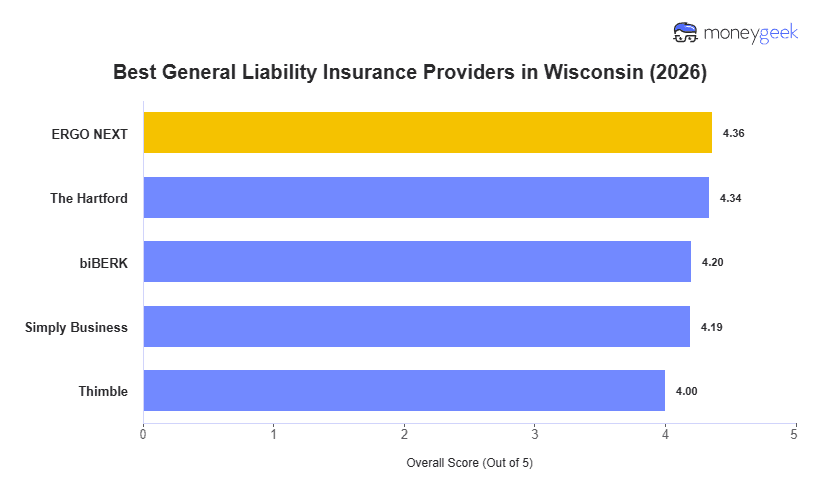
ERGO NEXT4.34$7518
The Hartford4.3$7382
Simply Business4.22$8324
biBERK4.2$7947
Thimble3.99$82610
Coverdash3.98$9192
Progressive Commercial3.93$9179
Chubb3.84$9851
Hiscox3.82$9836
Nationwide3.78$97105

For our Wisconsin general liability insurance ratings, we analyzed pricing, coverage options and customer experience across 408 industries statewide. Our analysis focuses on 1-to-4-person businesses, which represent a large share of Wisconsin's small business market, while weighting results for broader industry and location representation across the state's commercial centers and rural service areas, including the Fox Valley, Milwaukee metro, Northwoods region and western agricultural communities. 

To do this, we evaluated over 20,000 business profiles, more than 1,748 customer experience data points and reviewed coverage contracts and endorsements to compare how insurers serve Wisconsin businesses consistently across different industries and regions. 

We then rated each company across categories of affordability (50%), customer experience (30%) and coverage options and terms (20%) to form an overall rating. For a detailed breakdown of the metrics, scoring methodology and pricing analysis specific to Wisconsin, see our full methodology.

95%
% of Small Businesses Covered
Over 20,000
Business Profiles Studied
1,748
Customer Experiences Analyzed

Find the Best General Liability Insurer for Your Wisconsin Business

Select your industry and state to get a customized quote from your best general liability insurer match in WI.

Industry
State

Answer 2 questions and see your top insurer in seconds. 100% free.

Company Image
Best Overall, Best for Service and Trade Businesses

ERGO NEXT

The best general liability insurance company in Wisconsin is ERGO NEXT, which leads on customer experience and affordability. Wisconsin businesses can get a certificate of insurance without an agent, with pricing that doesn't change at binding, a pattern small business owners cite on Trustpilot and Reddit. Day-to-day policy management involves generating and sending COIs instantly through the app, though claims handling is less competitive since adjuster communication is slower and escalation options are limited.

ERGO NEXT performs well on affordability, being the cheapest option for 14 out of 25 general industries in our study. Businesses in hospitality, travel and tourism, construction and repair and maintenance see the most savings, ranging between 23% and 25%. It also offers the most affordable rates on average for solo operators and businesses with up to nine employees. Policies have the standard $1 million per occurrence/$2 million aggregate limits, and add-ons like tools and equipment and cyber liability are available through the platform.

Where ERGO NEXT performs best:

  • Solo operators and small crews that want quick, self-serve coverage
  • Trade and service businesses focused on keeping rates low
  • Owners who need to generate COIs often and prefer managing policies online
  • Low-claim-frequency businesses that don’t rely on local agent support

Where ERGO NEXT performs less competitively:

  • Wisconsin health care, fitness or education businesses trying to lower premium costs
  • Businesses with larger equipment that need inland marine or equipment floater coverage
  • Operations that expect hands-on claims support after a loss

Learn More: ERGO NEXT Review

Company Image
Best Cheap General Liability Insurance

The Hartford

Ranking second overall in Wisconsin is The Hartford with the most affordable general liability premiums and coverage depth that most competitors don't carry. Its GL policy covers defense costs outside policy limits, so legal fees don't reduce the coverage available for settlements and rented premises sublimits reach up to $500,000. Wisconsin contractors get a broad form endorsement that auto-includes blanket additional insured status, without needing to add it separately.

Several industries see double-digit savings, with education leading at 29%, followed by health care and medical at 26% and arts, media and entertainment at 22%. The Hartford also has the lowest average rates across all business sizes, from solo operators to mid-sized companies. You need an agent to purchase a policy, and the process takes longer than fully digital options, but that support pays off after purchase. Wisconsin businesses get COIs processed within four hours for contractor and landlord requirements, and customer reviews point to consistent communication and fair outcomes on claims.

Where The Hartford performs best:

  • Supports regulated or institutional businesses that need lower-cost coverage
  • Serves growing businesses with 10 or more employees across industries
  • Handles operations that require complex endorsements or contractor bonding
  • Provides hands-on claims support for businesses that prefer it over digital self-service

Where The Hartford performs less competitively:

  • Falls short for businesses that want instant digital onboarding or app-based COIs
  • Offers fewer savings for wholesale, agriculture or real estate businesses

Learn More: The Hartford Review

Company Image
Best for Consumer Service Businesses

biBerk

Competitive general liability rates and a highly positive customer experience make biBerk third overall. The fully digital platform suggests coverage options based on business inputs and binds coverage in minutes, with phone support available for those who want it. Post-purchase, COI delays and slow endorsement processing appear consistently across reviews. One policyholder reported waiting several weeks for certificates before leaving the carrier. Claims handling is mid-pack with no clear strength or weakness.

biBerk is most affordable for consumer-facing and activity-based industries. These include fitness services (21% savings), cleaning services and real estate and property services (20% savings each) and recreation and sports (18% savings). Coverage follows a standard GL structure with a useful endorsement menu, including cyber liability, liquor liability and tools coverage, but sublimit details aren't publicly documented and there's no contractor-specific broad form.

Where biBerk performs best:

  • Serves consumer service businesses that prioritize affordability
  • Fits low-COI-frequency businesses that prefer fully digital self-service
  • Supports food, beverage or fitness operations that want affordable online coverage
  • Works for mid-sized businesses with 20 to 49 employees comparing value across carriers

Where biBerk performs less competitively:

  • Falls short for contractors or landlord-facing businesses that need fast, reliable COIs
  • Offers fewer savings for wholesale, consulting or construction businesses
  • Limits options for operations that need complex endorsements or contractor-specific coverage features

Learn More: biBerk Review

Company Image
Best for Comparing Coverage Options

Simply Business

Unlike other traditional insurers, Simply Business places fourth overall in Wisconsin as a broker rather than a carrier. You can get quotes from multiple insurers simultaneously, such as Liberty Mutual, Hiscox, Travelers and Markel, allowing for broader carrier access and more coverage options when buying. Sublimits and endorsement terms vary by the carrier matched to your business, and the platform doesn't standardize them. 

The platform binds policies in minutes online and recommends coverage based on business inputs without requiring an agent. Post-purchase, policy changes and claims go directly to the underlying carrier, and reviewers report phone wait times exceeding an hour for platform support. Simply Business isn’t the most affordable insurer in Wisconsin, but businesses in beauty, childcare, repair and retail see modest savings, while tech and IT firms have the biggest costs advantage, saving 23%.

Where Simply Business performs best:

  • Tech and IT businesses wanting to save on premiums
  • First-time buyers wanting to compare multiple carriers at once
  • Businesses with straightforward coverage needs and low post-sale service requirements

Where Simply Business performs less competitively:

  • Wisconsin wholesale, marketing or construction businesses looking for affordable coverage
  • Operations needing predictable sublimits or specific endorsements across carriers
  • Businesses expecting hands-on support after the policy is bound

Learn More: Simply Business Review

Company Image
Best for Seasonal and Project-Based Businesses

Thimble

While most insurers lock you in for a year when purchasing general liability insurance, Thimble offers flexible terms, resulting in a fifth-place ranking. You can get coverage by the job, day, or month rather than annual contracts only for reasonable rates. While not the cheapest option, two industries see double-digit savings: construction businesses at 21% and manufacturers at 19%. Beyond those sectors, most Wisconsin businesses pay above or near the state average.

During the buying process, policies bind in minutes, COIs generate instantly at purchase. Post-purchase, there is no phone support, email responses take days and claims go entirely to third-party administrator Sedgwick rather than Thimble directly and reviewers report slow adjuster assignment and weak dispute resolution. Despite providing on-demand coverage, Thimble has a limited endorsement menu, though core GL limits are standard at $1 million per occurrence/$2 million aggregate.

Where Thimble performs best:

  • Supports contractors or manufacturers that need short-term project coverage
  • Issues instant COIs without requiring agent contact
  • Serves project-based or seasonal operations that want to avoid annual policy commitments
  • Offers affordable coverage options for mid-sized businesses with 20 to 49 employees

Where Thimble performs less competitively:

  • Falls short for businesses in hospitality, marketing or transportation seeking competitive rates
  • Lacks support for operations that expect phone assistance or hands-on claims management
  • Doesn’t meet the needs of businesses that require commercial auto or a broad endorsement stack

Learn More: Thimble Review

Explore the Best General Liability Insurance in Wisconsin by Industry

General liability premiums in Wisconsin vary by industry because insurers price based on the likelihood and severity of third-party claims. A Wausau tree service working on client properties carries far more exposure than a Madison graphic designer working remotely, so their premiums reflect that difference. 

These tables show estimated monthly rates and provider rankings by business type, so you can see where your operation fits.

What Determines the Best General Liability Insurance for Wisconsin Businesses

Wisconsin small businesses shopping for general liability insurance in Wisconsin often default to the lowest quote, but the provider that looks right at signing can fall short when a claim hits or a renewal arrives with a surprise increase. The four factors below separate insurers that price well on paper from those that hold up across the life of your policy.

    coins2 icon
    Affordability without pricing volatility

    A competitive starting premium means little if it climbs sharply at renewal. For Wisconsin businesses that run on tight seasonal margins, a Bayfield apple orchard, a Lake Geneva wedding venue or a Dells-area kayak rental operator can see real budget pressure with little warning when rates jump between policy cycles. 

    A claim, a change in your payroll or even a shift in how an insurer assesses your industry can trigger increases that compound year over year. Before committing, ask prospective insurers how rates have moved at renewal for businesses in your category over the past two to three years.

    talk icon
    Responsive service throughout your policy term

    Buying a policy is the easy part. The real test is what happens after, when you need a certificate of insurance before a job starts, when a client files a complaint after a catering event goes sideways or when you need to add a venue as an additional insured the morning of a Door County wedding booking. 

    Responsive service means the insurer is reachable and effective at the moments that affect your business. Look for an insurer that meets these touchpoints:

    • Gets a COI to a Northwoods resort contractor before a same-day job walkthrough
    • Walks a first-time claimant through next steps when a customer slips on an icy Milwaukee sidewalk outside a storefront
    • Updates a policy midterm when an Eau Claire food vendor adds a second farmers market location
    • Clarifies coverage quickly when a Wausau tree service receives a property damage complaint after a storm job

    When service breaks down at moments like that, it costs the business more than the premium ever would. Test responsiveness before you commit, so call or chat during business hours and note how quickly and clearly you get an answer.

    insurance2 icon
    Coverage options that fit common small business risks

    General liability policies share a common structure, but the depth of protection available and the ability to adjust it as your business grows varies by insurer. A Fox Valley remodeling company bidding on commercial renovation projects needs higher per-occurrence limits and additional insured status for general contractors, and not every insurer handles both equally well. 

    As that same company grows into larger commercial projects, hired and non-owned auto coverage becomes necessary when crews travel in rented or personal vehicles to job sites, and tools and equipment coverage matters when higher-value gear is regularly in transit or on-site at client properties. An insurer that can only offer a base policy leaves you shopping again when your operation outgrows it.

    building icon
    Why consistency across all three areas matters most

    An insurer strong in one area but weak in others creates a risk that doesn't surface until you need the policy to work. A Sheboygan manufacturer supplying retail clients could see a pricing surprise at renewal, a delayed response when a product liability question surfaces and a coverage gap when a client contract requires a specific endorsement, not as separate problems but as compounding ones. The providers worth choosing perform reliably across all three areas.

How to Choose the Best General Liability Insurance in Wisconsin

Wisconsin small businesses don't shop for general liability insurance the same way. A Minocqua fishing guide, a Racine printing shop and a Madison software consultant are all looking for coverage, but their risk profiles, contract requirements and budget constraints pull them in different directions. The steps below walk through a logical sequence for narrowing options before a quote ever enters the picture:

  1. 1

    Optimize your payment and coverage structure

    Know what your operation needs before you compare providers. Wisconsin businesses range from low-contact service work to hands-on trades with daily public exposure, and that gap shapes both your coverage limits and what you'll pay.

    Ask yourself:

    • Do your contracts require specific coverage limits or additional insured status, which many Wisconsin contractors need for municipal or commercial bids?
    • Does your work involve property, products or equipment that could cause third-party damage, as seen in construction and manufacturing sectors across Wisconsin?
    • Do you run a seasonal operation, like many Door County tourism businesses, where monthly payments may work better than a single annual payment?
    • Can a higher deductible reduce your premium enough to fit your budget without creating cash flow risk at claim time, which matters for businesses with tight off-season margins?

    Know how much general liability coverage you need before you buy to avoid over- or under-buying. A Stevens Point bookkeeper or a Madison-area personal trainer can work within standard limits. Higher-risk operations like Wausau demolition contractors or Eau Claire event production companies often need broader limits and should weigh annual payment options, which run cheaper than monthly billing.

  2. 2

    Choose your primary priority

    No insurer is equally strong across every dimension. Your current business situation should determine which one matters most, and that becomes your tiebreaker when two providers look nearly identical on paper.

    Your situation points to your priority:

    • Prioritize pricing predictability if your business runs on tight or seasonal margins where a renewal increase would create real budget pressure. Wisconsin's seasonal economy spans tourism, agriculture and outdoor recreation, and rate stability beats chasing the lowest opening quote in any of those sectors.
    • Prioritize service and responsiveness if your work depends on fast documentation or quick midterm adjustments. A Waukesha electrical contractor juggling multiple job sites can't spend hours chasing a COI, and a Fox Valley wedding vendor adding venues mid-season needs policy updates in hours, not days.
    • Prioritize coverage depth and flexibility if your operation is growing or your clients set the coverage terms. A Green Bay janitorial company landing its first hospital contract and a La Crosse remodeler bidding on school district work may find that standard limits fall short. Review your general liability limits before committing to a policy that may not keep up with your next contract.
  3. 3

    Shortlist two to three providers

    Skip comparing every insurer you come across since it wastes time and muddies the decision. A shortlist keeps the process focused on providers that actually fit your situation. Use your priority from step two as the first filter, then cross-check it against your industry and business size. 

    Wisconsin general liability costs vary by business type and location, so a provider that ranks well statewide may not suit a five-person plumbing operation in Eau Claire or a solo esthetician in Appleton. Focus on two or three providers that perform well in your priority area and write policies for businesses like yours.

  4. 4

    Double-check for dealbreakers before investing more time

    Confirm non-negotiables early. Remove any provider that fails these checks:

    • Industry eligibility: Hemp and agritourism operations, hunting and fishing guides and some food processing companies hit eligibility walls that never come up for general service businesses. Check your classification early, before you build a shortlist.
    • Coverage limits: DOT highway projects and school district renovations come with state contract minimums that a base policy won't meet. Know your required limits before you request a single quote.
    • Endorsement availability: Wisconsin landscapers, tree services and mobile food vendors hauling equipment across multiple locations need hired and non-owned auto and tools coverage baked in. Don't shortlist a provider until you've confirmed both are available.
    • Certificate turnaround: Spring through early fall, Wisconsin's construction and events seasons stack up fast and compress project timelines. One slow COI can knock a subcontractor off a job before work even begins.
  5. 5

    Compare your finalists using the same three lenses

    Evaluate each provider using consistent criteria. Strength in one area doesn't offset weakness in another.

    • Pricing stability: Review renewal trends, audit handling and how insurers communicate rate changes. A Northwoods outfitter renewing mid-season can see budget disruption from a pricing change unrelated to claims.
    • Service performance: Check COI turnaround, how providers handle policy changes and how claims support works in practice. A Sheboygan plumbing contractor cannot wait days for a certificate while a project stalls.
    • Coverage fit: Look closely at per occurrence and aggregate limits, endorsement availability and how easily the policy adjusts as your operation grows. A Fond du Lac general contractor adding commercial remodeling work to a residential portfolio will hit endorsement and limit requirements that a base policy wasn't built to handle.
  6. 6

    Use quotes as the final confirmation step

    At this stage, you have a shortlist of providers that fit your priority, clear your dealbreakers and hold up across all three lenses. General liability quotes confirm whether the pricing holds for your actual business details. Your Wisconsin location, the nature of your work and any seasonal or project-based variables all shape your final exposure profile. 

    A quote for a Bayfield tourism operator looks nothing like one for a Milwaukee-area staffing firm, even at the same coverage limit. Before signing, go through general liability exclusions carefully. What a policy doesn't cover matters as much as what it does.

Best Small Business General Liability Insurance in Wisconsin: Bottom Line

ERGO NEXT, The Hartford and biBerk lead the rankings for small business general liability insurance in Wisconsin, though the strongest match shifts with your line of work, operational complexity and how your business grows over time. 

The right approach weighs pricing stability, service responsiveness and coverage depth together rather than defaulting to the lowest quote. This produces a policy that holds up across the full policy lifecycle, from certificates and midterm changes to claims, not at signing.

Best General Liability Insurance For Small Business in Wisconsin Chart

Best General Liability Insurance for Small Businesses in Wisconsin: Next Steps

Narrow your options to one or two providers and confirm pricing and availability using the same coverage assumptions across each. That keeps comparisons clean and shows which insurer offers the best combination of affordability and policy features for your Wisconsin operation, where seasonal exposure, client contract requirements and the nature of your work all shape what a policy needs to do.

If cost is still your main deciding factor

If you’re unsure how much coverage you need

If you’re ready to check quotes now

Find the Best General Liability Insurer for Your Wisconsin Business

Select your industry and state to get a customized quote from your top general liability insurance match in WI.

Industry
State

Answer 2 questions and see your top insurer in seconds. 100% free.

How We Chose the Best General Liability Insurance Companies

To identify the best general liability insurance companies for Wisconsin small businesses, we evaluated insurers across pricing, customer experience and coverage options using a standardized, data-driven approach. Our goal was not to identify the cheapest option in every scenario, but to determine which providers offer the most consistent overall value across common Wisconsin small business profiles.

Our best recommendations reflect insurers that perform well across multiple dimensions and remain competitive across industries and business sizes in Wisconsin.

Data and Analysis Scope

We based our analysis on standardized estimates that represent the majority of Wisconsin small businesses:

  • Providers analyzed: 10 major insurers serving Wisconsin
  • Industries covered: 408 industries
  • Employee counts: Zero to 49 employees
  • Policy baseline: $1 million per occurrence/$2 million aggregate general liability policy
  • Pricing modeled: Over 20,000 standardized estimates for Wisconsin businesses

Modeled average revenues and payrolls were incorporated to improve pricing accuracy for Wisconsin's business landscape.

Our Scoring Model

Each insurer received a composite score based on the weighted categories below.

  • Affordability (50%): Affordability reflects how competitively and consistently an insurer prices general liability coverage across all Wisconsin business profiles studied.
  • Customer experience (30%): Customer experience measures how well insurers support Wisconsin businesses throughout the policy lifecycle from purchase to claims. We also studied at each level of buying, policy management and claims sub-parts of the process that make it easier and more reliable within each as well for accuracy and comprehensive understanding.
  • Coverage options (20%): Coverage options reflect how well insurers support common Wisconsin small business risks and allow for flexibility as businesses grow or change.

Read our full business insurance methodology.

About Angelique Palenzuela-Cruz


Angelique Palenzuela-Cruz headshot

Angelique Palenzuela-Cruz is a Content Writer at MoneyGeek specializing in business insurance. She focuses on general liability, workers' compensation and professional liability coverage, helping small business owners cut through policy jargon and understand what they're actually buying.

Angelique has spent over five years reporting on personal finance, with deep experience in both insurance and lending markets. Her psychology background also gives her a unique understanding of how people actually process difficult financial decisions, allowing her to meet readers where they are, simplify complex concepts and build decision making frameworks that give them confidence. Whether you're learning about policies, comparing providers or trying to figure out requirements, Angelique does the legwork, digging into regulations, analyzing policy language and testing her explanations against agent-level standards so you get straight answers without fluff.