




Choose where to jump to based on your needs:
Best Dog Insurance
Updated: September 21, 2026
Advertising & Editorial Disclosure
Best Pet Insurance Companies for Dogs
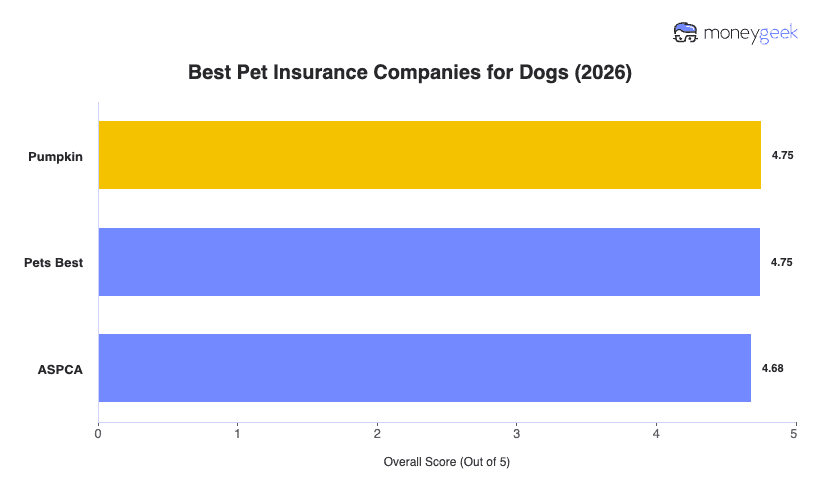
The following companies offer the best pet insurance for dogs:
- Choose if you want the best value with excellent claims service: Pumpkin
- Choose if you want the lowest rates and direct vet payment: Pets Best
- Choose if you want the most flexibility for policy customization: ASPCA
Finding the best providers involved comparing coverage options and terms, focusing on their flexibility for customizing policies, waiting periods, pre-existing condition rules and base plan inclusions. I also evaluated each one’s affordability and customer service for buying, policy management and claims.
For our best dog insurance ratings, we evaluated affordability, customer experience and coverage across 18 major pet insurers using over 67,000 dog profiles representing mixed breeds and purebreds in all 50 states and Washington, D.C. Our analysis used a base profile of an 6-year-old Labrador Retriever with a $5,000 annual limit, $500 deductible and 80% reimbursement rate to ensure consistent comparisons across providers.
We analyzed pricing competitiveness across different breeds and locations, measured customer experience throughout the policy lifecycle from enrollment to claims and assessed coverage quality for dog-specific health risks. Each insurer received a composite score based on affordability (50% of overall score), customer experience (30% of overall score) and coverage options and terms (20% of overall score).
For a detailed breakdown of the metrics, scoring methodology and analysis approach, see our full methodology.

Pumpkin: Best Pet Insurance for Dogs Overall
pros
Top-tier customer service
Short waiting period for orthopedic issues
Expedites claim reviews and reimbursements
cons
Limited options for policy customization
14-day waiting period for accident coverage
COMPANY HIGHLIGHTS
Pumpkin is my pick for the best dog insurance overall, outperforming for customer experience. It offers top-tier service that makes it easy for dog owners to purchase a policy, manage their account and submit a claim after a vet visit. The company also has Pumpkin Now, an urgent pay service that expedites claims for high-cost care of $500 or more that are submitted at the vet, depositing up to 90% reimbursement within 20 minutes to eligible bank accounts, which you can use to pay at checkout to reduce your upfront expenses.
However, Pumpkin falls short on coverage flexibility, with only two reimbursement rates, four deductibles and four annual limits, so you have fewer options to tailor your policy's premium and out-of-pocket costs to your specific budget and coverage needs. It also requires a 14-day waiting period for accidents, which is not ideal for active or adventurous dogs that may be more likely to experience injuries shortly after enrollment.
Learn more: Pumpkin Pet Insurance Review

Pets Best: Best Cheap Dog Insurance
pros
Cheapest provider for dogs
Short accident waiting period
Direct vet payment option
cons
Frequent issues with submitting claims
Exam fees and physical therapy need add-ons
COMPANY HIGHLIGHTS
Another recommendation for the best dog insurance is Pets Best, which offers the lowest average rate of $40 monthly and provides 34% savings against the national benchmark for comprehensive coverage. Its base plan allows dog owners to access broader financial protection for breed-related health risks, behavioral treatment and ongoing medication without having to purchase add-ons. Pets Best also has the shortest waiting period for accidents, between zero and three days based on state, so active or energetic dogs that have higher likelihood of accidental injuries can have coverage sooner.
Additionally, Pets Best’s Vet Direct Pay feature allows the company to settle covered claims with your vet directly, reducing your upfront costs to just your deductible, co-insurance and non-covered items, which is particularly valuable when your dog needs expensive emergency or specialty care. However, Pets Best isn’t as competitive for customer service, with claim submission ease being its weakest area. This may make it more difficult for dog owners to submit claims smoothly and efficiently, especially when additional documentation is required.
Learn more: Pets Best Pet Insurance Review
ASPCA: Best Dog Insurance for Coverage Flexibility
pros
Widest range of coverage options
Competitive average rates for dogs
Comprehensive base plan inclusions
cons
Accident waiting period lasts 14 days
Less smooth policy management and claims experience
COMPANY HIGHLIGHTS
ASPCA is my pick for the best dog insurance if you’re looking for coverage flexibility. It offers three reimbursement rates, four deductibles and six annual limits, giving you more ways to tailor your premiums, out-of-pocket costs and coverage limits based on your budget and your dog's potential veterinary needs. The company also provides a broad base plan that covers exam fees, physical rehabilitation and alternative treatments like acupuncture and hydrotherapy, so you’re financially protected if your dog develops a condition requiring frequent veterinary visits, mobility support or ongoing rehabilitative care.
That said, ASPCA falls at the bottom half of my analysis at 16th place out of 18 for customer experience. Its weakest areas are policy management and claims, which can leave dog owners dealing with added hassle when managing their policy, accessing coverage information or submitting claims when their dog needs veterinary care.
Learn more: ASPCA Pet Insurance Review
Cheapest Pet Insurance Companies for Dogs
The cheapest pet insurance for dogs are offered by:
- Pets Best: As the most affordable dog insurance provider, Pets Best averages $40 a month, which translates to 34% savings against the national average. The company provides its biggest savings to small and toy breeds, specifically Chihuahuas and Australian Terriers.
- ASPCA: At $41 monthly, ASPCA is the second-cheapest dog insurance provider, 33% below the national average. It offers its lowest rates across the Northeast, Mid-Atlantic and West Coast, with West Virginia having the most affordable rates.
- Pumpkin: Pumpkin ranks third for low-cost dog insurance at $43 a month, saving owners 30% compared to the national average. Its affordability advantage is concentrated in specific medium-sized breeds, namely English Pointers, Hungarian Vizslas, Peruvian Hairless Dogs and Samoyeds.
Pets Best | $40 | $483 | 34% |
ASPCA | $41 | $491 | 33% |
Pumpkin | $43 | $513 | 30% |
How Much Does Dog Insurance Cost?
The average cost of pet insurance for dogs is $61 per month ($737 annually). This rate reflects a plan for a 6-year-old Labrador Retriever with a $5,000 annual limit, $500 deductible and 80% reimbursement rate. How much you’ll pay can range from $33 to $129, depending on factors like coverage selection, breed, geographic location and age.
You can use MoneyGeek’s pet insurance calculator below to get a more personalized estimate for your dog.
Dog Insurance Cost Estimate Calculator
Select Breed
Select Age
Average monthly rate—
Select Breed
Average monthly rate—
Select Age
Is Dog Insurance Worth It?
Whether dog insurance is worth it depends on your dog's age, breed and existing medical history, as these factors affect both the likelihood of costly veterinary care and the coverage available to you. Enrolling earlier can help financially protect against future unrelated accidents and illnesses, while your dog's breed and health history can indicate whether broader coverage for hereditary, chronic or other conditions may be especially valuable.
Another consideration is how much you could pay in vet bills if your dog develops a serious condition or suffers an unexpected injury. Based on MoneyGeek’s vet cost data, treatment for these common health issues can cost:
- Hip dysplasia: $3,330 to $26,629
- Cancer (lymphoma): $3,639 to $18,198
- Cruciate ligament tear: $5,459 to $12,738
- Periodontal disease: $394 to $2,628
- Bloat: $6,383 to $25,533
After considering whether getting a policy is worth it for your dog, determine your pet insurance coverage needs using MoneyGeek’s tool below. Enter your pet’s species, breed, state and age to get a personalized recommendation before you start collecting quotes.
Dog Insurance Coverage Needs Calculator
Use this calculator to get pet insurance coverage recommendations by entering your pet's species, breed, state and age.

What is your pet type?
Select Pet type
Pet type
Breed
State
Pet Age
Best Dog Insurance Buying Checklist
Refer to this checklist while collecting dog insurance quotes and speaking with insurers, and use the accompanying downloadable PDF to record each item you accomplish. Work through the process in order so you can match coverage to your dog's health risks, identify important policy differences and compare quotes on the same terms.
Download: Best Dog Insurance Buying Checklist
 Identify your dog's specific health risks
Talk with your veterinarian about health conditions your dog may be more likely to develop based on its breed, age, size, lifestyle and activity level. For example, ask whether your dog is at increased risk for hereditary conditions, chronic diseases, cancer or dental problems, and note any conditions that could require ongoing or lifelong treatment. Use your veterinarian's input to identify the coverage terms that matter most, such as hereditary condition coverage, chronic condition coverage, physical rehabilitation or short accident and orthopedic waiting periods.
- Determine how much coverage you need
Decide whether your dog is best suited to an accident-only plan, accident-and-illness coverage or a comprehensive policy with an optional wellness plan based on which veterinary expenses you want the policy to help pay. Then choose a deductible based on how much you can afford to pay toward a covered claim before pet insurance reimburses you, an annual limit based on the maximum amount you would want the insurer to pay for covered care in a policy year, and a reimbursement rate based on how much of eligible costs you want the insurer to pay after meeting your deductible.
- Research pet insurance providers
Create a shortlist of pet insurance companies that offer coverage in your state, then look for each provider's online sample policy and check terms that are particularly relevant to your dog, including:
- Pre-existing condition rules: Confirm the policy has a clearly defined pre-existing condition rule that limits exclusions to conditions or symptoms present before coverage begins.
- Curable condition terms: Look for dog insurers that have a symptom- and treatment-free period of under 12 months after which a curable pre-existing condition can become eligible for coverage.
- Waiting periods: Find providers with waiting periods of zero to three days for accidents, 14 days or less for illnesses and less than 12 months or waived waiting periods for orthopedic conditions.
- Cancer treatment: Make sure the policy provides broad coverage for cancer diagnostics and treatment, without requiring an optional add-on or unusually restrictive condition-specific limits.
- Hereditary conditions: Find pet insurance companies that cover hereditary conditions in the base plan without breed-specific exclusions or the need for costly add-ons.
- Dental illnesses: Verify that coverage for dental illnesses and medically necessary treatment are included in the base policy.
- Alternative therapy: Confirm that the insurer provides coverage for alternative therapies like acupuncture, chiropractic care and physical rehabilitation without requiring expensive add-ons.
- Read customer reviews
Read recent customer reviews with particular attention to claims handling, customer support, reimbursement and disputes over medical records or coverage, since these issues can affect how easily you receive reimbursement when your dog needs veterinary care. Check multiple sources, including Trustpilot, the Better Business Bureau (BBB) and Reddit communities such as r/dogs and r/petinsurancereviews, and look for recurring patterns. Use these reviews to identify potential service problems worth asking each insurer about before you enroll.
- Get quotes
Request quotes from your shortlisted providers using the same deductible, annual limit and reimbursement rate so the rates are directly comparable. As you review each quote, check whether benefits such as prescription medications, dental illness, exam fees and physical therapies are included in the base policy or require optional add-ons, particularly when another insurer includes them by default. Comparing standardized quotes alongside included benefits and optional coverage can give you a clearer picture of which dog insurance policy offers the best overall value for your situation.
Best Dog Insurance: Bottom Line
Pumpkin, Pets Best and ASPCA lead as the best pet insurance companies for dogs. The right choice for you will depend on your dog's age, breed, health risks and existing medical history, as well as how much you're comfortable paying for coverage. Before enrolling, compare each provider's coverage options and terms, affordability and customer experience to find the policy that best fits your dog's needs.
Best Pet Insurance for Dogs: FAQ
For dogs, the top pet insurance companies providing coverage are:
- Pumpkin: Best Pet Insurance for Dogs Overall
- Pets Best: Best Cheap Dog Insurance
- ASPCA: Best Dog Insurance for Coverage Flexibility
Based on my analysis, Pets Best offers the cheapest dog insurance at an average rate of $40 per month, which is 34% below the national benchmark. However, this is the lowest monthly rate on average, and yours will vary based on your dog's breed, location and age.
Dog insurance costs $61 per month ($736 annually) on average for a 6-year-old Labrador Retriever under a policy with a $500 deductible, $5,000 annual limit and 80% reimbursement. Your actual premium will differ depending on your dog's breed and age, where you live and how much coverage you choose.
Dog insurance is worth it if you want financial protection against accidents, illnesses and breed-specific conditions before they become pre-existing exclusions. A single emergency surgery can cost hundreds or thousands of dollars and an unexpected diagnosis can drain your savings fast. Whether your large dog or small dog needs pet insurance depends on its breed risks and lifestyle, your location's vet costs and your current budget.
Buying dog insurance involves identifying your pet’s health risks with your veterinarian, determining how much coverage you need, researching pet insurance companies, reading customer reviews and collecting multiple quotes.
Whether you're insuring a small dog or a large dog, pet insurance helps pay for eligible vet expenses related to unexpected accidents and illnesses. Depending on the policy, this may include exam fees, prescription medications, alternative therapy, specialist visits and treatment for covered hereditary or chronic conditions. Routine care, such as vaccinations and wellness exams, is generally excluded unless you purchase an optional add-on.
The ideal time to get dog insurance is when your dog is young and healthy, before symptoms of a potentially expensive condition appear. Since insurers exclude pre-existing conditions, waiting until your dog needs treatment could leave that condition uncovered.
Get Dog Insurance Quotes
Use MoneyGeek’s tool below to find the top pet insurance companies that suit your dog's specific health needs and your budget.
About Ritchel Mendiola

Ritchel Mendiola is a Pet Insurance Content Writer at MoneyGeek. She produces coverage guides, provider comparisons and cost analyses so pet owners can understand their options and avoid overpaying.
Ritchel spent over four years as a News and Feature Writer at Asian Journal Publications, where she reported for the Asian Journal newspaper and Balikbayan Magazine, conducted interviews and covered media events. At MoneyGeek, she covers policy terms, exclusions, waiting periods and reimbursement structures the way she treated news facts. They're sourced, verified and reported accurately rather than summarized from marketing copy.
She joined MoneyGeek in late 2021 in the loans vertical and moved to pet insurance content, which she now leads. Her published work includes provider comparisons, breed-specific cost guides, age-specific coverage analyses and state-level pricing studies, all from the vertical's 5 million pet insurance profiles across 18 major providers and all U.S. states.
LinkedIn: https://www.linkedin.com/in/rianmendi/
Contact Email: ritchel.mendiola@moneygeek.com