




After nearly a decade analyzing car insurance rates, I've seen the same driver pay $43 a month with one insurer and nearly double that with another for identical coverage. Age, driving record and credit history explain those differences.
Cheapest Car Insurance Companies for 2026
Updated: September 29, 2026
Advertising & Editorial Disclosure
Cheapest Car Insurance Companies and Monthly Rates for August 2026

Full and Minimum Coverage
- Full coverage: Travelers at $97
- Minimum coverage: GEICO at $43

Teen, Young Adult and Senior Rates
- Teens (16 to 19): National General at $118
- Young adults (20 to 24): National General and GEICO at $80
- Seniors (65+): GEICO at $83

Rates After Violations
- Speeding ticket: State Farm at $56
- At-fault accident: State Farm at $62
- DUI: National General at $66
- Texting while driving: GEICO at $55
- Not-at-fault accident: GEICO at $45

Good and Poor Credit Rates
- Good credit: Travelers at $97
- Poor credit: Nationwide at $165
Cheapest Minimum Coverage Car Insurance Companies
GEICO is the cheapest insurer in our analysis at $43 a month. National General charges $5 more at $48 a month. The gap from GEICO to fifth-place Amica at $56 is $13. At that spread, claims handling and customer service matter as much as rate. Choose GEICO if price is your only priority. Other carriers in the top five score higher on customer service, and the cost difference is a few dollars a month.
| Geico | $43 | $514 | 36% |
| National General | $48 | $579 | 28% |
| Travelers | $50 | $601 | 25% |
| State Farm | $53 | $634 | 21% |
| Amica | $56 | $669 | 17% |
Cheapest Full Coverage Car Insurance Companies
Travelers has the cheapest full coverage car insurance nationwide at $97 a month. GEICO is $1 more at $98.
With rates this close, discounts and how you buy the policy determine which is cheaper for you.
GEICO's military and federal employee discounts cut rates 12% to 15%. Multi-vehicle households save up to 25%. Clean-record drivers save up to 26% through the good driver discount. Stack those, and GEICO's effective rate can drop below Travelers.
Travelers sells through agents. Go that route if your coverage needs are complicated or you'd rather have someone walk you through your options. GEICO's app lets you get quotes, update your coverage and file claims without picking up the phone.
| Travelers | $97 | $1,158 | 29% |
| Geico | $98 | $1,177 | 28% |
| National General | $112 | $1,340 | 18% |
| Amica | $115 | $1,381 | 16% |
| State Farm | $121 | $1,448 | 11% |
Cheapest Car Insurance Companies by State
GEICO prices aggressively for clean-record drivers. After an accident or a credit drop, though, rates climb faster than at most standard carriers. State Farm holds steadier across risk profiles.
GEICO posts the lowest rate in 24 states for minimum and full coverage, more than any other national carrier. State Farm wins in lower-density states, including Idaho ($18 a month for minimum coverage), Montana, Vermont and North Carolina, where its rural pricing model holds an edge. Travelers leads in the Northeast corridor, Florida and Nevada.
The cheapest company in your state isn't always the cheapest for your profile. If your record or credit isn't clean, run quotes from at least the two cheapest options here before deciding.
| Alabama | Geico | $42 | $86 | $35 |
| Alaska | Geico | $41 | $87 | $203 |
| Arizona | Travelers | $41 | $83 | $234 |
| Arkansas | Geico | $39 | $89 | $85 |
| California | Geico | $39 | $91 | $244 |
| Colorado | Geico | $32 | $97 | $326 |
| Connecticut | Geico | $34 | $75 | $544 |
| Delaware | Travelers | $48 | $78 | $468 |
| District of Columbia | Geico | $86 | $152 | $604 |
| Florida | Travelers | $52 | $112 | $352 |
| Georgia | Geico | $40 | $101 | $142 |
| Hawaii | Geico | $24 | $66 | $210 |
| Idaho | State Farm | $18 | $56 | $118 |
| Illinois | Geico | $30 | $69 | $198 |
| Indiana | Geico | $33 | $64 | $51 |
| Iowa | State Farm | $20 | $66 | $103 |
| Kansas | Geico | $25 | $71 | $237 |
| Kentucky | Travelers | $47 | $94 | $190 |
| Louisiana | Geico | $54 | $156 | $326 |
| Maine | Travelers | $28 | $52 | $75 |
| Maryland | Geico | $51 | $89 | $238 |
| Massachusetts | Amica | $35 | $82 | $18 |
| Michigan | Travelers | $25 | $70 | $200 |
| Minnesota | State Farm | $33 | $91 | $49 |
| Mississippi | Progressive | $54 | $105 | $129 |
| Missouri | Geico | $38 | $81 | $106 |
| Montana | State Farm | $19 | $85 | $324 |
| Nebraska | Geico | $27 | $68 | $0 |
| Nevada | Travelers | $57 | $105 | $310 |
| New Hampshire | Geico | $33 | $61 | $116 |
| New Jersey | Amica | $86 | $142 | $126 |
| New Mexico | State Farm | $37 | $95 | $101 |
| New York | Progressive | $34 | $64 | $100 |
| North Carolina | State Farm | $24 | $56 | $236 |
| North Dakota | Geico | $28 | $61 | $51 |
| Ohio | Travelers | $36 | $74 | $15 |
| Oklahoma | Progressive | $29 | $96 | $138 |
| Oregon | State Farm | $39 | $82 | $128 |
| Pennsylvania | Travelers | $30 | $70 | $35 |
| Rhode Island | State Farm | $43 | $88 | $199 |
| South Carolina | Geico | $58 | $112 | $107 |
| South Dakota | Progressive | $14 | $55 | $195 |
| Tennessee | Travelers | $38 | $78 | $123 |
| Texas | State Farm | $41 | $93 | $266 |
| Utah | Geico | $46 | $90 | $241 |
| Vermont | State Farm | $22 | $56 | $137 |
| Virginia | Travelers | $30 | $61 | $97 |
| Washington | State Farm | $38 | $96 | $115 |
| West Virginia | Geico | $42 | $92 | $309 |
| Wisconsin | Geico | $20 | $53 | $41 |
| Wyoming | Geico | $15 | $76 | $190 |
Cheapest Car Insurance Companies for Teens
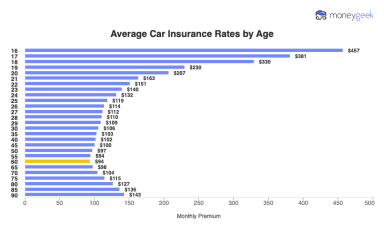
Teen rates are the highest of any age group, and the cheapest insurer changes at almost every age. State Farm is cheapest for 16-year-olds at $271 a month, 22% below the national average. By age 19, National General is cheapest at $118 a month, 29% below average.
How to save on teen car insurance:
- Stay on a parent's policy. A family policy at the same address costs less than a standalone policy through the early 20s.
- Stack State Farm discounts. The good student discount saves 15% to 25% for teens with a B average and stacks with Steer Clear for drivers under 25 with clean records.
- Compare at every renewal. Run quotes from the top carriers in the table for your teen's current age, not the age they were when you last shopped.
Cheapest Car Insurance Companies for Young Adults
National General is the cheapest car insurance company for young adults at $88 a month for minimum coverage, 29% below the national average. GEICO follows at $94 and Travelers at $115. Young adult rates drop 30% to 50% from teen levels. They're still higher than what the same driver pays in their 30s and 40s. The gap narrows each year.
National General is the price leader through 23. Its customer service and claims satisfaction scores are lower than GEICO's, though. If you're likely to file a claim or want a better app, GEICO's $6 monthly premium difference is worth it.
Young drivers in their early 20s can stay on family policies if they're at the same address or away at school.
Cheapest Car Insurance Companies for Seniors
GEICO has the cheapest minimum coverage car insurance for seniors at $83 a month, 13% below the national average. For full coverage, National General leads at $167 a month. That's $4 less than GEICO's $171.
Rates start rising again around age 70, when accident frequency picks up. Seniors who drive fewer than 7,500 miles a year can offset part of that increase through GEICO's low-mileage discount or Progressive's Snapshot program. Mature driver discounts and home-auto bundling can also trim costs at renewal. Many seniors qualify for both and never use them.
| Geico | $83 | $171 | 13% |
| Amica | $89 | $187 | 6% |
| National General | $90 | $167 | 12% |
| State Farm | $95 | $189 | 3% |
Cheapest for Drivers With Violations or Bad Credit
A speeding ticket, at-fault accident, DUI or texting violation raises your rates. Insurers price that added risk into your premium, and the surcharge varies by carrier. The insurer cheapest with a clean record is rarely the cheapest after a violation. In our analysis, shopping around after any incident saves $400 to $900 a year. At renewal, most drivers stick with their current carrier without shopping. That's the most expensive mistake we see.
State Farm/GEICO | $56 | $129 (Travelers) | ||
State Farm | $62 | $137 (Travelers) | 27% cheaper | |
National General | $66 | $158 (Travelers) | 29% cheaper | |
GEICO | $55 | $126 | 29% cheaper | |
GEICO | $45 | $103 | 29% cheaper | |
Nationwide | $165 | $164 | 29% cheaper | |
How to Get the Cheapest Car Insurance Rates
The gap between the cheapest and most expensive insurer for the same driver ranges from $1,200 to $8,500, per our shopping data. Pairing the right carrier with stacked discounts cuts your premium 10% to 30% below the base rate.
- 1
Determine how much coverage you need before you get a quote
Most drivers skip coverage decisions and go straight to price comparison. Your liability limits should reflect your assets, your lender requirements if you're financing and your state minimums. Get this wrong, and you're underinsured or paying for coverage you don't need. See our guide to how much car insurance you need.
- 2
Start with your profile, not an insurer
Most drivers start by searching online for a carrier name they recognize. That's the wrong starting point. Each insurer prices driver profiles differently. The cheapest carrier for your neighbor may be among the most expensive for you. Find your category first in the tables above: teen, young adult, senior, military, clean record or violation on file.
- 3
Include at least one regional insurer in your research
Regional insurers are cheapest in nearly half of all states. Most drivers never quote them because they don't advertise nationally. Check the state tables above for the regional carrier that leads in your state before you lock in a shortlist.
- 4
Improve your profile over time to lower your rate
Your rate isn't fixed. Age, driving record, credit and mileage all affect it. Each one improves with time and effort.
- Driving record: Most violations fall off after three to five years. After one clean year, your rate starts dropping at the next renewal.
- Credit score: A credit score jump from poor to good cuts premiums by 30% to 50% in most states. That saves more than a clean year on your driving record.
- Age: Rates drop at 25 as insurers move you out of the high-risk young driver bracket. Keep your record clean heading into that milestone, and the rate drop is bigger.
- Mileage: Drivers under 7,500 miles a year qualify for low-mileage discounts at most major insurers. If your driving has decreased, update your estimate at renewal.
Car Insurance Discounts to Get Cheaper Car Insurance
Most insurers have 10 or more discounts. Not all apply to every driver. Three of the easiest don't require enrollment, a documentation request or a call to your agent:
- Pay in full: Pay your annual premium upfront instead of in monthly installments, and the discount applies right away at most carriers. Paying in full saves 5% to 10% and eliminates monthly processing fees.
- Multi-vehicle: Add a second car to the same policy, and the discount applies automatically. Available at all five cheapest carriers.
- Bundle home and auto: Move your home or renters policy to the same carrier as your auto, and the discount stacks on top of your base rate.

Bottom Line and Next Steps
No single car insurance company is the cheapest for every driver. The cheapest option depends on your age, driving record, credit history and the coverage level you need.
For most clean-record adults, Travelers and GEICO are the right starting points. After a violation, the cheapest carrier shifts by incident type: State Farm for a speeding ticket or at-fault accident, National General for a DUI and GEICO for a texting violation.
Through age 23, National General leads for young adults on price, though its claims satisfaction scores are lower. Shopping around consistently beats staying with one insurer. For the same driver and coverage level, the gap between the cheapest and the most expensive can reach thousands of dollars a year.
Next Steps
- Find your profile in the tables above and note the two cheapest carriers for your situation.
- Get quotes from both, plus the leading regional carrier in your state.
- Stack every discount you qualify for before comparing final rates.
- Set a renewal reminder to requote. The cheapest carrier today may not be the cheapest in six months.
Frequently Asked Questions About the Cheapest Car Insurance
Car insurance rates vary more than most drivers expect, often by hundreds of dollars a year for identical coverage.
At every renewal, which is every six or 12 months. Rates change frequently. The carrier that was cheapest last year may not be cheapest today. In our research, drivers who requote at every renewal and switch when the numbers support it pay less than those who renew without shopping.
Almost always. At-fault accidents raise rates at most carriers for three to five years. Not-at-fault accidents can also raise rates at some insurers. GEICO and State Farm are among the most forgiving on this. Minor claims where the payout is close to your deductible usually aren't worth filing.
Yes, in most states. Poor credit (scores below 580) roughly doubles rates compared to drivers with good credit. California, Hawaii and Massachusetts ban credit-based pricing, so your score won't affect your rate there. Everywhere else, a higher credit score is one of the fastest ways to bring your rate down.
Shop the same coverage level across multiple insurers and pick the lowest price. That's the right move. Cutting coverage to get a lower rate isn't. Minimum coverage won't pay for damage to your own car. It also won't cover injuries or property damage if your liability limits run out after a serious accident. Find the lowest rate for coverage that actually covers what you'd owe: 100/300/100 liability plus comprehensive and collision for cars worth more than $8,000.
South Dakota, Wyoming, Idaho, Montana and Iowa have the lowest average car insurance rates. Fewer people on the road means fewer claims. State regulations in these markets also keep costs down. Rates start as low as $14 a month for minimum coverage, per MoneyGeek's analysis.
Most of the time. Bundling home and auto insurance with the same company saves 10% to 25% on your premium. GEICO's multi-policy discount reaches 25%. State Farm's bundling discount runs 10% to 20%. In some cases, buying each policy separately from the lowest-cost provider on that line beats bundling on total price.
Loading...
MoneyGeek pulls rate data from Quadrant Information Services across every residential ZIP code in the U.S. The base profile is a 40-year-old man with a clean record driving a 2010 Toyota Camry LE 12,000 miles a year. Minimum coverage rates reflect each state's required liability limits. Full coverage uses 100/300/100 liability with a $1,000 comprehensive and collision deductible. Age, violation and credit sections substitute the relevant characteristic for the base profile while everything else stays constant. Teen rates reflect a 16 to 19-year-old driver. DUI rates add that conviction, and bad-credit rates use a sub-580 score.
Rankings within each section score carriers on affordability (60%), customer experience (30%) and coverage options (10%). The affordability score normalizes each carrier's rate against competitors within that driver profile. Customer experience draws from J.D. Power surveys, NAIC complaint indexes, AM Best ratings, agent network ratings and Google Business ratings. Coverage options reflect the number and variety of add-ons each carrier has.
Lowest Car Insurance Rates: Related Pages






About Mark Fitzpatrick

Mark Fitzpatrick is a licensed Property and Casualty (P&C) Insurance Producer and MoneyGeek's resident expert in insurance and economics. In nearly a decade covering the insurance market at LendingTree and MoneyGeek, he's analyzed hundreds of carriers and millions of rates across auto, home, renters, health and life insurance.
His work has appeared in The Washington Post, The New York Times and NPR. He draws on independent cost and consumer experience data, and no insurance company partnerships affect his recommendations.
Mark studied at Boston College and later earned a master's in economics and international relations from Johns Hopkins University. He worked in financial risk management at State Street before joining MoneyGeek. He's also a five-time “Jeopardy!” champion.
Sources
- Centers for Disease Control and Prevention. "Older Adult Drivers." Accessed September 7, 2026.
- Centers for Disease Control and Prevention. "Risk Factors for Teen Drivers." Accessed September 7, 2026.