
How Much Does Food Truck Business Insurance Cost?

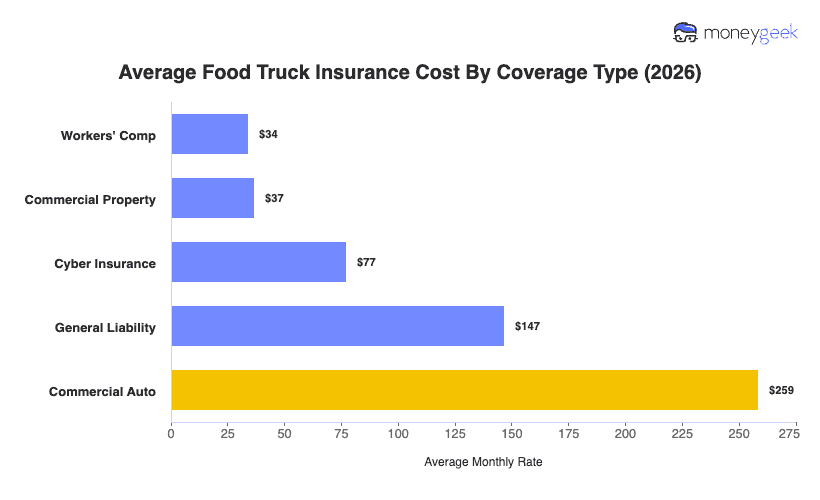
Food business insurance costs vary across business types. For food truck operators, MoneyGeek's analysis puts the average at $111 per month, or $1,327 per year, across five common coverage types for businesses with one to four employees across all 50 states and Washington, D.C.

Individual coverage costs range from $34 per month for workers' comp to $259 for commercial auto. Most food truck operators are owner-operators who work the truck themselves, sometimes adding part-time help for markets or events. That keeps the payroll base small, and workers' comp premiums follow. Commercial auto reaches the top because the truck carries both road risk and the replacement value of onboard cooking equipment. The table below reflects benchmark averages, not carrier-issued quotes.

Workers' Comp$34$408120
Commercial Property$37$439164
Cyber Insurance$77$929215
General Liability$147$1,759307
Commercial Auto$259$3,103362

We analyzed quote data from major U.S. commercial insurance providers and modeled standardized premium estimates across business profiles representing around 95% of the market. Results are designed to provide a consistent national benchmark showing how premiums vary by key baseline factors including business size, restaurant profession type, location and vehicle type for operations that use commercial vehicles.

Dataset Scope and Assumptions

Our cost modeling uses standardized inputs for consistent comparisons across businesses.

  • Total estimates modeled: just over 6 million standardized pricing estimates
  • Providers analyzed: 10 major insurance providers
  • Geography: all U.S. states including Washington, D.C.
  • Employee count bands: solo practitioners, one to four, five to nine, 10 to 19, and 20 to 49 employees
  • Vehicle types studied: Sedans, SUVs, pickup trucks, vans, taxis, limousines, tractors, food trucks, semi-trucks (non-HAZMAT and HAZMAT), tanker trucks (non-HAZMAT and HAZMAT), buses, box trucks, dump trucks, flatbed trucks
  • Policies studied: general liability, workers' comp, professional liability, commercial auto, commercial property, and cyber insurance
    • General liability: $1 million per occurrence and $2 million aggregate
    • Workers' comp: state required coverage
    • Professional liability: $1 million per claim and $1 million aggregate
    • Commercial auto: minimum coverage
    • Commercial property: personal property coverage limits personalized to industry, business size and state
    • Cyber insurance: $1 million per occurrence and $1 million aggregate

How We Calculated Average Food Truck Business Insurance Costs

Our published averages represent modeled premiums for standardized business profiles and were aggregated in two ways.

  • National benchmark average: The national average cost reflects the modeled premium for a standardized one to four employee business across all restaurant profession categories and states included in our dataset for a standard professional liability policy
  • Segment averages: To show how costs vary, we calculated average modeled premiums for our national base profile and isolated for variables, including:
    • Employee count (business size ranges)
    • Profession / industry categories
    • Vehicle types (for commercial auto)
    • States (including Washington, D.C.)

Segment averages were produced by aggregating modeled pricing trends across the full dataset so readers can compare how premiums shift across profession types and regions.
See our full business insurance methodology.

The food truck business insurance cost calculator below lets you get more personalized estimates to compare rates.

Get Food Truck Business Insurance Cost Estimates

Plug in your coverage type, state, employee count and vehicle type (if you need commercial auto coverage) to get a cost estimate built around your operation. No personal information is required, and workers' comp estimates are calculated per employee. Once you have a good basis, click Get Quotes to be directed to your top food truck business insurer for pricing.

Select Coverage Type
Select State
Select Employee Count
Select vehicle_type
Monthly Rate Estimate—

How Much Does General Liability Insurance Cost for Food Truck Businesses?

General liability insurance covers the third-party bodily injury and property damage claims that food truck operators face at service windows, events and commissary sites, and event organizers and market operators require proof of it before they'll let you park. General liability costs for food truck range from $95 per month in West Virginia to $243 in Washington, D.C.

Local litigation costs and legal defense in D.C. likely contribute to the 155% gap. If your route includes high-cost states like California or New York, build that premium variance into your budget before you book the season.

Alabama$109$1,314
Alaska$177$2,134
Arizona$149$1,784
Arkansas$103$1,234
California$241$2,893
Colorado$185$2,211
Connecticut$201$2,411
Delaware$157$1,884
District of Columbia$243$2,918
Florida$172$2,060
Georgia$138$1,654
Hawaii$196$2,344
Idaho$107$1,286
Illinois$179$2,150
Indiana$124$1,485
Iowa$110$1,324
Kansas$116$1,388
Kentucky$116$1,391
Louisiana$113$1,361
Maine$127$1,522
Maryland$196$2,354
Massachusetts$218$2,616
Michigan$133$1,600
New Mexico$109$1,311
Minnesota$160$1,918
Mississippi$97$1,165
Missouri$122$1,461
Montana$111$1,335
Nebraska$116$1,394
Nevada$154$1,852
New Hampshire$160$1,921
New Jersey$205$2,457
New York$229$2,751
North Carolina$133$1,592
North Dakota$114$1,373
Ohio$130$1,557
Oklahoma$111$1,332
Oregon$170$2,043
Pennsylvania$156$1,875
Rhode Island$157$1,887
South Carolina$107$1,282
South Dakota$103$1,237
Tennessee$127$1,522
Texas$144$1,726
Utah$132$1,586
Vermont$148$1,775
Virginia$169$2,035
Washington$200$2,394
West Virginia$95$1,144
Wisconsin$128$1,538
Wyoming$109$1,306

How Much Does Commercial Auto Insurance Cost for Food Truck Businesses?

For a food truck, commercial auto coverage means insuring the truck itself: the vehicle you drive to pitches, events and commissary kitchens every day, and the one the law requires you to cover the moment it's used for business. The gap in commercial auto insurance costs lies how food trucks operate. You'll pay around $77 per month in Iowa, but if you're in Washington, D.C. that figure more than doubles at $161.

Stopping to serve customers in high-traffic locations where road incidents are most frequent, not just passing through. Food trucks operating in high-traffic metro areas face greater road exposure per mile, higher repair costs and larger injury settlements when incidents occur. If your truck is garaged in California, New York or Michigan, all costing more than $150 per month, factor that into your annual budget rather than the national average.

Alabama
$92
$1,103
Alaska
$153
$1,843
Arizona
$105
$1,265
Arkansas
$92
$1,110
California
$156
$1,869
Colorado
$120
$1,442
Connecticut
$139
$1,666
Delaware
$107
$1,288
Florida
$139
$1,669
Georgia
$107
$1,286
Hawaii
$98
$1,171
Idaho
$79
$946
Illinois
$127
$1,528
Indiana
$99
$1,194
Iowa
$77
$923
Kansas
$94
$1,131
Kentucky
$99
$1,191
Louisiana
$109
$1,302
Maine
$110
$1,323
Maryland
$135
$1,620
Massachusetts
$144
$1,725
Michigan
$155
$1,863
Minnesota
$113
$1,359
Mississippi
$93
$1,112
Missouri
$111
$1,337
Montana
$89
$1,074
Nebraska
$91
$1,090
Nevada
$113
$1,358
New Hampshire
$97
$1,166
New Jersey
$144
$1,727
New Mexico
$88
$1,061
New York
$154
$1,841
North Carolina
$107
$1,278
North Dakota
$103
$1,234
Ohio
$123
$1,478
Oklahoma
$95
$1,143
Oregon
$114
$1,368
Pennsylvania
$90
$1,075
Rhode Island
$125
$1,499
South Carolina
$101
$1,213
South Dakota
$102
$1,223
Tennessee
$99
$1,185
Texas
$128
$1,537
Utah
$99
$1,189
Vermont
$85
$1,023
Virginia
$118
$1,421
Washington
$142
$1,708
Washington D.C.
$161
$1,932
West Virginia
$94
$1,130
Wisconsin
$91
$1,097
Wyoming
$107
$1,289

How Much Does Workers’ Comp Insurance Cost for Food Truck Businesses?

Workers' comp is legally required in most states once you bring on staff, and food truck kitchens and service windows create genuine exposure since burns, cuts and slips are among the most common claims in mobile food operations. 

The cost for workers' comp coverage run per employee per month, ranging from $19 in Indiana to $79 in California. State-set rate schedules and benefit structures drive that $60-per-employee gap, not differences in how food trucks actually operate. California's benefit levels and regulatory framework push its rates to more than four times Indiana's. If you're planning to hire, even one part-time worker for weekend markets, your state will be one of the most consequential variables in what workers' comp costs you.

Alabama$22$268
Alaska$55$659
Arizona$27$325
Arkansas$19$234
California$79$950
Colorado$34$413
Connecticut$62$743
Delaware$42$500
District of Columbia$72$866
Florida$31$375
Georgia$30$359
Hawaii$42$507
Idaho$21$251
Illinois$44$531
Indiana$19$226
Iowa$20$243
Kansas$22$268
Kentucky$24$285
Louisiana$32$380
Maine$30$360
Maryland$36$435
Massachusetts$57$679
Michigan$35$423
Minnesota$35$414
Mississippi$21$257
Missouri$28$334
Montana$28$337
Nebraska$22$263
Nevada$30$354
New Hampshire$36$433
New Jersey$59$705
New Mexico$25$299
New York$62$743
North Carolina$27$320
Oklahoma$28$338
Oregon$32$380
Pennsylvania$44$522
Rhode Island$37$443
South Carolina$31$371
South Dakota$20$235
Tennessee$24$293
Texas$23$280
Utah$22$261
Vermont$32$381
Virginia$25$304
West Virginia$29$353
Wisconsin$29$346

How Much Does Commercial Property Insurance Cost for Food Truck Businesses?

A grease fire, equipment failure or break-in can shut your truck down entirely. Your policy covers the cooking equipment, onboard supplies and fixtures that make the truck a functioning business. The average cost of commercial property insurance ranges from $32 per month in North Dakota to $44 in New York and while the 36% gap reflects property crime rates and local repair costs, the value of your onboard equipment is a bigger driver of what you actually pay. A custom-built kitchen with commercial fryers and a generator warrants a different coverage limit than a basic cold-prep setup.

Alabama$34$410
Alaska$41$486
Arizona$37$439
Arkansas$33$397
California$42$508
Colorado$38$456
Connecticut$41$488
Delaware$38$458
District of Columbia$42$509
Florida$41$495
Georgia$36$436
Hawaii$43$516
Idaho$35$417
Illinois$38$453
Indiana$34$405
Iowa$33$392
Kansas$33$392
Kentucky$34$405
Louisiana$38$456
Maine$35$416
Maryland$39$471
Massachusetts$41$496
Michigan$35$419
Minnesota$36$431
Mississippi$33$401
Missouri$33$401
Montana$34$406
Nebraska$32$389
Nevada$37$448
New Hampshire$36$432
New Jersey$42$507
New Mexico$34$409
New York$44$522
North Carolina$37$439
North Dakota$32$385
Ohio$35$418
Oklahoma$34$403
Oregon$38$460
Pennsylvania$39$462
Rhode Island$40$475
South Carolina$36$431
South Dakota$32$388
Tennessee$35$418
Texas$39$465
Utah$36$430
Vermont$35$419
Virginia$37$447
Washington$39$474
West Virginia$33$398
Wisconsin$34$414
Wyoming$33$397

How Much Does Cyber Insurance Cost for Food Truck Businesses?

Most food trucks now take card payments through Square, Toast or a similar platform, making payment data the primary cyber exposure in the operation. A breach can trigger state-mandated notification requirements and third-party costs that a general liability policy won't cover.

Washington, D.C. sits has the highest cyber liability cost at $96 per month partly because it imposes some of the strictest breach notification requirements in the country, including short disclosure deadlines and broad definitions of what counts as personal data. If your route runs through high-regulation markets, factor that into what you budget for cyber insurance.

Alabama$75$895
Alaska$65$790
Arizona$78$944
Arkansas$71$854
California$91$1,094
Colorado$84$1,006
Connecticut$88$1,061
Delaware$86$1,033
District of Columbia$96$1,147
Florida$83$1,003
Missouri$77$923
Georgia$82$987
Hawaii$70$836
Idaho$67$806
Illinois$88$1,059
Indiana$77$926
Iowa$69$833
Kansas$73$878
Kentucky$75$895
Louisiana$75$895
Maine$70$834
Maryland$88$1,057
Massachusetts$88$1,061
Michigan$78$941
Minnesota$78$942
Mississippi$71$851
Montana$65$789
Nebraska$69$833
Nevada$86$1,033
New Hampshire$70$834
New Jersey$90$1,075
New Mexico$71$854
New York$94$1,122
North Carolina$81$967
North Dakota$65$790
Ohio$78$944
Oklahoma$73$878
Oregon$81$970
Pennsylvania$81$967
Rhode Island$70$834
South Carolina$75$895
South Dakota$67$806
Tennessee$77$926
Texas$84$1,005
Utah$73$880
Vermont$70$834
Virginia$86$1,030
Washington$86$1,032
West Virginia$67$806
Wisconsin$77$923
Wyoming$65$790

Factors Affecting Food Truck Business Insurance Costs

Unlike most small businesses, a food truck functions as a commercial vehicle, a licensed food service operation and a customer-facing retail environment simultaneously. Which of those dimensions drives your food truck business insurance costs depends on your specific setup. A truck running a full propane kitchen on a festival circuit sits differently than a cold-prep trailer at a fixed pitch.

    fryingPan icon
    Cooking equipment and heat sources

    If your truck runs propane systems, deep fryers or commercial grills, those heat sources affect how insurers price your policy. Operating that equipment inside a moving vehicle adds fire exposure a fixed kitchen doesn't carry. A cold-prep or pre-packaged menu places your truck in a lower fire-risk tier.

    rideshare icon
    Operating model

    A food truck parked at the same office pitch every weekday carries more predictable exposure than one covering farmers markets, food festivals and private catering across multiple locations. Running a multi-county circuit, adding alcohol service or stacking event weekends each shifts your risk profile in ways a fixed pitch doesn't.

    money2 icon
    Annual revenue

    Food trucks can swing between a quiet Tuesday lunch doing a few hundred dollars and a festival weekend clearing several thousand. Underwriters use annual revenue to assess how much liability exposure your customer volume creates: more service means more food handling and more potential claims from a foodborne illness or customer injury.

    pickupTruck icon
    Truck age and build

    Many food trucks are converted vehicles, and your build's age and condition affect how underwriters approach replacement value and mechanical risk. A 20-year-old converted step van sits in a different risk tier than a purpose-built commercial unit. Generator mounts, cold-side additions and service window extensions can each shift your classification.

    smallBusiness icon
    Off-truck operations

    If you prep at a commissary kitchen, serve at client sites or run indoor pop-ups, your liability exposure extends beyond the truck. A slip-and-fall at the commissary or property damage at a catered event may fall outside your standard policy unless those locations are specifically addressed in your coverage.

How to Lower Food Truck Business Insurance Costs

Cheap food truck business insurance starts with knowing which levers actually move the needle for your operation. Some, like comparing quotes across the smaller pool of insurers that understand mobile food operations, can lower what you pay at renewal. Others, like adjusting your route or investing in safety practices, reduce your risk profile over time and strengthen your position at renewal.

    vsDocuments icon
    Compare quotes using the same coverage limits

    Food truck insurance is priced differently across providers: some bundle general liability and commercial auto into a single package, others quote them separately. At minimum, make sure each quote covers the same general liability limit for events, the same commercial auto scope for the truck and the same property value for your equipment. Without matching structure, a lower price may reflect less coverage rather than a better rate.

    uninsured icon
    Right-size your coverage

    Right-sizing runs in both directions for food truck operators. If your truck is an older converted vehicle, insuring it at replacement cost rather than actual cash value may cost more than it's worth. If you work events or markets, check that your general liability limits meet what organizers require. A $1 million minimum is common.

    shoppingBag icon
    Bundle policies with the same provider

    When your commercial auto and general liability sit with different insurers, a single incident at the truck can become a dispute over which policy responds first. Specialty insurers focused on mobile food businesses often package general liability, commercial auto, workers' comp and commercial property together at a lower combined rate. Bundling also eliminates the gap dispute risk: one insurer handles claims that touch multiple coverage lines.

    insurance2 icon
    Lower your risk profile

    Moving from a high-volume festival circuit to a more consistent fixed pitch, switching from propane to electric cooking equipment, or completing a food safety certification can each shift how underwriters assess your risk. Underwriters re-assess your operation at each renewal, so route changes, equipment upgrades and certifications completed during the policy period show up in the next quote.

    stackOfBooks icon
    Invest in risk management practices

    For food trucks, the claims that tend to trigger renewal scrutiny are kitchen fires, foodborne illness reports, customer injuries at the service window and road incidents in the truck. Addressing the most common ones systematically is what builds the claim-free history that moves your rate at renewal.

    • Install a fire suppression system in your cooking area, especially if you run open-flame equipment, to reduce fire-related claim exposure.
    • Make sure anyone handling food on your truck holds a current food handler certification, which documents your safety practices and limits foodborne illness claims.
    • Fit a dashcam on the truck and maintain a vehicle service log so you have documentation if a road incident becomes a commercial auto dispute.
    • Keep records of commissary kitchen inspections and off-truck prep procedures so claims arising at those locations have the compliance documentation to support a defense.

Food Truck Business Insurance Cost: Bottom Line

The $111 monthly average is a reference point, not a prediction. Individual food truck quotes diverge from it based on the setup: truck age, route, cooking equipment and crew.

Food truck quotes combine vehicle, kitchen and liability costs, making it harder to judge whether a quote is actually competitive. These questions help locate where yours actually falls:

  1. Where do you fall in the distribution? Use your coverage types, employee count and state as starting coordinates. A solo cold-prep operator in a lower-cost state sits below the $111 average; a staffed festival truck with a full hot kitchen sits above it. If your quote doesn't match your profile, that gap is worth investigating.
  2. Is your quote consistent with your risk profile? Food truck quotes above the benchmark usually trace to commercial auto costs, cooking equipment risk or operating model. Check whether those drivers actually apply to your truck. If your setup is straightforward but your quote is high, that's a signal to compare across at least two other providers before deciding.
  3. Which cost drivers apply to your business? A cold-prep truck at a fixed pitch and a propane-kitchen truck on a festival circuit share a classification but little else. Go through the factors on this page and identify which ones describe your actual operation. Those are the drivers most likely to explain where your quote landed.

The gap between a benchmark and a real quote almost always traces back to a small number of operation-specific inputs, not the full list. Understanding which inputs are doing the work matters more than knowing the distance. Use the benchmarks here to locate yourself, then look at the drivers.

Food Truck Business Insurance Cost: Next Steps

If you're still working out which coverage types apply to your truck, start with what your state requires and what your event or commissary contracts specify. Those two sources usually define the minimum you need to carry.

If you're ready to find a better rate, compare quotes from providers that specialize in mobile food businesses rather than general small business insurers. Ask each one to quote the same coverage structure so the price difference reflects the provider, not the policy.

If your quote came back higher than the benchmarks

If you're just starting out as a food truck operator

If you're adding a second truck to your fleet

If your truck only operates part of the year

About Connor Bolton


Connor Bolton headshot

Connor Bolton is Senior SEO and Content Manager at MoneyGeek, where he leads the business and pet insurance editorial teams. As editorial lead for both verticals, Connor sets the research framework, data standards, and content structure that his writers execute, directly authoring in-depth guides himself and reviewing all team content for accuracy and practical value before it goes live. With over four years evaluating insurance products across personal, commercial, and specialty lines, he brings cross-vertical knowledge to every guide the team produces.

Connor architected MoneyGeek's insurance research infrastructure across all major verticals including auto, home, renters, life, health, business, and pet, building systems for pricing analysis, provider-level research, customer experience evaluation, and coverage analysis with AI support. The infrastructure includes over 6 million data points for business insurance across 408 industry areas, all 50 states, and 16 vehicle types, and over 5 million pet insurance profiles across 18 major providers and hundreds of breed and age combinations. Connor's insurance cost research and his team's work has been cited by the U.S. Chamber of Commerce, Allstate, Liberty Mutual, CBS News, Forbes and LegalZoom.

Beyond the data, Connor stays connected to how the market actually operates, drawing on direct conversations with underwriters and carrier liaisons at Ethos, The Hartford, NEXT Insurance, Nationwide, and State Farm, and monitoring business and pet owner communities including Reddit, to inform how he interprets findings and frames guidance for real buyers.

He is the direct editorial contact for methodology questions at connor@moneygeek.com and can be found on LinkedIn.